June 17, 2009

What was Gary Becker hiding?
$10,274.28 will provide some answers

What else was Gary Becker hiding?

Our former mayor quietly (if not secretly) negotiated a deal with SC Johnson to save the company hundreds of thousand of dollars per year and net the city hundreds of thousands of dollars for Becker's Uptown Artist Relocation program.

He also bought a $40,000 sculpture from an artist he was trying to lure to Uptown ($40,000 conveniently happened to be the amount the artist needed for a down payment on his building).

Then, setting aside his alleged Internet habits, there are series of other allegedly questionable deals and relationships he engaged in during his six years as mayor - many we may never know about. But we can still ask the question: What was Gary Becker hiding?

One existing glimpse into Becker's legacy as mayor exists on city computers, or more specifically, on city-owned data tapes. Every email Becker sent as Racine's chief executive is stored away as a public record, legally available to the public.

But while the records are open to the public, they're not necessarily available.

RacinePost filed a records request for Becker's emails and was quoted a price of $10,274.28 to fulfill the records request. Here's the explanation of the cost from Assistant City Attorney Nicole Loop:
I relayed your request ("all of Gary Becker's emails from his time as mayor (2003-2009)") to MIS Director Paul Ancona and he provided me with information on the process and costs.  Per Mr. Ancona, the retrieval will be done from backup tapes using DAT tapes.  As to the retrieval process, the department would first need to retrieve the offsite tapes and load them (1.5 hours of time).  Then, they would need to go to each year-end tape, retrieve the mailboxes, go through them and retrieve Becker's mailbox.  This process would take about three hours per tape (7 years x 3 hours = 21 hours).  Then, they would need to read through the restored mailboxes and retrieve his e-mails, process them into a form that can be read outside of exchange, and save it to electronic format.  This process would take approximately 2 hours per tape (7 years x 2 hours = 14 hours).

I would need to review all of the e-mails to prevent the release of information that may be confidential or otherwise protected by law, which is even more time-consuming than the above processes. On an estimate of 100 e-mails per day sent and received, that's about 26,100 e-mails per year (using 261 work days-subtracting the weekends). Assuming I can get through 8,700 e-mails in an 8-hour work day, I would estimate that it would take me 3 days per tape (8 hours x 3 days = 24 hours x 7 years = 168 hours). This is an extremely conservative estimate.

The cost to the city to locate this information would be $51.35 per hour for the MIS Department's time, and $50.00 per hour for the City Attorney Office's time. Wis. Stat. 19.35(3)(c) permits the city to charge the "actual, necessary and direct cost" of locating the materials if the fee is $50 or more. In this case, I estimate the actual, necessary and direct cost of locating the materials you requested to be $10,274.28 (36.5 hours x $51.35 = $1874.28; 168 hours x $50.00 = $8400.00). If it took less time, you would receive a refund; if it took more time, you would be required to pay the additional costs. If you wish to proceed with the request, we would require pre-payment of the entire estimated amount.
I believe it's within the public's interest to make these emails available to the public. If we're going to learn from Becker's mistakes, we have to bring them to light. These emails are a step toward fulfilling this critical task.

Legal or not, such a review shouldn't cost $10,274.28. It shouldn't cost a penny to review the actions of an elected official, particularly an elected official who left in a cloud of suspicion. We're asking the City Council to direct the release of these emails to the citizens of Racine at no cost. We believe it is their duty as overseers of the executive branch to undertake this exercise in the name of good and open government.

No doubt the emails will contain uncomfortable truths for powerful city leaders. Many people reading these words may have the thought: "What did I ever write to the mayor? Do I want that public? Probably not."

Others will argue that it's time to move on and leave the past as past. We have a new mayor and local officials are settling in to work on balancing the budget, reducing crime and attracting jobs and development. Looking back only promises to resurrect old wounds.

Both thoughts are misguided. Wounds fester when covered in the darkness and heal when brought into the open. But more simply, the public has a right to know. Enough question marks have been raised about our previous mayor to demand a full review of his actions. Releasing these emails to the public would be a good start.

Council votes to bring back one outsourced IT employee

The City Council back-tracked on a previous decision to outsource an information system employee, voting Tuesday to return the jobs to city employ. The move is expected to save about $14,000 next year.

The council voted 8-5 to remove the infrastructure manager from its contract with Velocity Partners to provide technical support for the city. Aldermen Jeff Coe, Michael Shields, Jim Kaplan, David Maack and Robert Mozol voted against the motion.

Coe had proposed reinstating a programmer position along with the infrastructure manager, but after a flury of procedural questions, the council voted against the idea.

The vote adjusted a contract the city signed with Velocity Partners in 2007 (Read our previous story here). At the time, the idea was a technology company would do a better job managing the city's computer systems than city employees because it would have more flexibility and a better grasp of emerging trends. Money was not a consideration because the city didn't expect savings from the five outsourced positions.

But the decision to outsource was made when the city didn't have a director for its information systems department. Once Paul Ancona was hired to lead the department - called Management Information Systems - a review of MIS suggested the city should have a dedicated employee to manage sensitive data systems, particularly police and fire systems.

The council's vote Tuesday night creates the dedicated position while retaining the city's relationship with Velocity Partners.

Aldermen Bob Anderson, Sandy Weidner, Terry McCarthy, Ray DeHahn, Greg Helding, Aron Wisneski, Jim Spangenberg and Tom Friedel voted for returning the infrastructure managemement position to the city.

Alderman Ron Hart was excused from the meeting and City Council President QA Shakoor II, who ran the meeting, was a non-voting member.

Sebastian's wins praise from OnMilwaukee.com

Patrice and Scott Sebastian in their restaurant's kitchen

Sebastian's in Caledonia received a big shout-out this week from OnMilwaukee.com -- a glowing restaurant review that may force us locals to make reservations earlier, or be shut out by interlopers from the big city.

"Dive into something ethereal," suggests food writer Amy Schubert, after recounting the restaurant's history, decor and menu. She says Sebastian's is an "enticing reason" to visit Caledonia, for a "surprisingly comfortable, casual, yet high-end dining experience in one of the more beautiful restaurant spaces in our area."

Scott and Patrice Sebastian are understandably pleased with the good review (by no means their first), but they're equally eager to discuss the garden Patrice is growing behind the restaurant -- visible from the dining room's picture window -- on a portion of their five-acre site. OnMilwaukee.com calls it an herb garden, but the raised beds house just as many vegetables. The garden is mostly Patrice's domain -- it is she who has a degree in horticulture, after all -- but Scott says it's also turning into his hobby.

"It's very fulfilling," he says, "planting it, tending it, harvesting and cooking it." He also keeps track of the downside, noting that "three bean plants are missing," presumably becoming dinner for local rabbits.

Growing fresh vegetables fits perfectly with the Sebastians' desire to serve fresh, healthful food. They shop at the farmers' market each week, and buy as much locally grown food as possible: pork, lamb and poultry from organic farms in Racine County. Of course, the seafood that makes up a large part of their menu comes from farther away...

The restaurant is approaching its ten-year anniversary; they opened on Jan. 19, 2000, and are already thinking of ways to celebrate. This was not their first restaurant -- as OnMilwaukee.com notes, they have a long history in Milwaukee, where Patrice was a community organizer and Scott a fireman when they opened their first place -- a lunch and catering-only cafe. (They also ran the Yellow Rose in downtown Racine, at the corner of Main and Fourth Streets, for five years, closing it last summer when the building's owner needed the space for his own business.)

As OnMilwaukee.com notes, Sebastian's is "high end," more expensive than the neighborhood pizza places Milwaukeeans usually seek out in Racine. So how has the economic decline affected it? "The effect is noticeable," Scott says, "especially when you try to serve the quality of food we serve." Still, they appear to have weathered the initial storm; "Things are more or less back where they were," he says, although instead of an $80 bottle of wine, diners are choosing a $40 bottle. "I thought it would be a lot worse." They've reacted by adding a specially priced dinner on Friday nights: For $19.95 diners get soup or salad, a choice from two entrees and dessert.

Sebastian's, located at 6025 Douglas Ave., is open for dinner Tuesday through Saturday.

June 16, 2009

Local urban gardeners meet movement's godfather

Will Allen speaking at Wingspread Tuesday

It was just a month ago that the healthy food / urban gardening movement sprouted here, with a meeting at DP Wigley, followed a week later by the first public meeting of Eat Right Racine.

On Tuesday afternoon, the godfather of that movement -- Will Allen, founder of Milwaukee's Growing Power, Inc. and the winner of a $500,000 MacArthur Grant in 2008 -- spoke to a full house at Wingspread, defining the problem in no uncertain terms and laying out the solution he's developed over 16 years in Milwaukee -- producing jobs, teaching life skills to youths and, above all, raising healthy food sustainably.

How bad are things right now? Pretty bad, Allen said:
  • "Our food system is broken."
  • "More disease is related to food; young people are obese; we deliver really bad food to schools."
  • "In the '30s and '40s, people grew food in their backyards. Now we've industrialized the system; we grow food that actually kills people."
  • "All our soil is contaminated."
  • "Since the 1950s, our food has 50 per cent less nutrients."
" I'm probably preaching to the choir," Allen said, laying out some of the successes Growing Power has had, and giving his audience ample (healthy, organic, sustainable) food for thought -- a growing plan for the future.

Growing Power began in 1993 when Allen -- son of a Southern sharecropper ("We had no money or car, but we had the riches of plenty of food.") -- bought the last farm in Milwaukee, two acres that he has turned into the nexus of an international movement ("This is a mainstream movement," Allen said. "It's not hippies and tree-huggers.") with 14 growing sites in Milwaukee, public gardens in Chicago, conferences at The Hague, Netherlands, workshops, farmers' markets and co-ops, and on and on. (Click summary at right to enlarge.)

Tomorrow Growing Power will host the mayor of Milwaukee ("He'll probably be wearing a suit, but we'll kick some dirt on it."). Allen is grateful for "politicos... interested in the food system." In Chicago's Grant Park, it has a $50,000 annual contract to produce urban gardens -- the same cost of traditional landscapers. On top of City Hall there, he says, there are bee hives ... an idea he plans to run by Milwaukee Mayor Tom Barrett.

Growing Power has been successful working with large corporations: It picks up food waste from Kohl's corporate headquarters, where 3,900 people are fed each day; from Rockwell, where 2,000 are fed (and now have access to a farmers' market); it now supplies vegetables to 10 Milwaukee schools; it composts 24 million pounds of food waste a year -- mostly from food wholesalers whose shipments arrive unsalable, or moldy hay bought from farmers.

Growing Power manages to raise roughly $5 worth of food annually from every square foot of its land, some $200,000 per acre. That compares, Allen said, to the typical roadside farmer's yield of about $500 per acre. It does that with intensive "vertical" planting in its greenhouses, aquaponics (raising fish in barrels), and intensive composting.

Allen's audience learned more about worms than they might have bargained for. He is a big proponent of vermiculture -- the raising of worms to turn waste into compost. "Worms live over 50 years; did you know that?" he asked the audience. (Most, it's safe to say, did not.) "We have to treat them as urban livestock." Warming to his subject, Allen said "there are 5,000 people in Seattle now engaged in raising worms for composting." Good news, too: 10 pounds of worms will become 40 pounds in four months, and so on...

More importantly, if contaminated soil is the problem -- and it is -- worms are the solution. "Remediation happens; worms actually digest lead dust and e-coli." Furthermore, Growing Power sells bags of "Black Gold" -- um, worm "casings."

"It's all about the soil," he says. "It's not about whether you have a green thumb, or any other color thumb."

Allen also raises Black Soldier Flies -- food for fish and chickens -- and goats for artisan cheese; laying chickens, ducks, heirloom turkeys that sell for $30 apiece, and bees for honey.

Intensive production, is the answer, he says. "This is the future of agriculture."

What will grow here from the ground Allen fertilized? Well, we already have the Racine Urban Garden Network, which appears to have poked through the soil after the initial city garden meetings. So far, it has a website under development and a growing list of interested organizations. DP Wigley offers "market basket" shares of locally grown produce. Eat Right Racine co-founder Heidi Fannin is working on a "Food Miles" initiative, to tell consumers how far away their food was grown. Growing Power, which does not sell at any of Racine's farmers' markets, appears willing to do so. "We have plenty of product," Allen said; "All we need is a sales person." Looking around the room, it appeared many were willing to step forward.

The SC Johnson Foundation, which sponsored Allen's appearance, got his sustainability message loud and clear. Lois Berg, who opened the session, noted that this Wingspread Briefing was different in some respects from previous ones: 46 per cent of the invitations were sent by email, she said; the after-meeting survey would be conducted without paper, again by email; there were none of the usual 3x5 cards for audience questions -- wireless microphones were used instead; and 90 per cent of the food served at the after-session reception was locally sourced.

Allen gave one final suggestion to participants. Noting that less than 1 percent of the food consumed in most cities is grown locally, Allen said, "We need 50 million people like you who will grow food. Till up some of your lawn; grow it in pots; or on your fire escape."

"This movement is not a movement any more," Allen said. "It's a revolution."

Housing Authority 'surprised' by negative reaction to Sixth Street plan

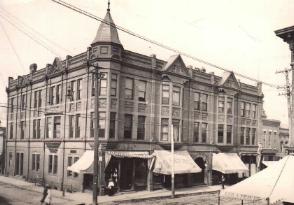
314 Sixth St., built in 1886

It's clear where Downtown business owners stand on the Housing Authority of Racine County's proposal to convert an historic Sixth Street building into low-income apartments.

"Who's in favor of this thing?" Monte Osterman asked a group of about 30 business owners Tuesday during a Downtown Connections meeting.

No one said a word.

Linda Ring Weber, executive director of the Housing Authority, said she was stunned by the reaction to the idea of renovating the former YMCA and Red Cross Building at 314-324 Sixth St.

"Surprised is such an understatement," Weber said. "There has to be some misunderstanding."

At issue is the need, or desire, for low-income housing on Sixth Street. Devin Sutherland, executive director of Downtown Racine Corp., is leading the opposition to the proposal. He said Sixth Street, or really anywhere Downtown, isn't a good site for additional low-income housing.

"It's market-rate apartments we don't have enough of," Sutherland said.

But Weber said she has a five-year waiting list for people seeking affordable housing from her agency. People who qualify for her program pay 30 percent of their income for rent - well under the low-income housing rates in places like the Arcade Apartments or Belle Harbor Apartments in Downtown.

Weber said the Housing Authority has received an overwhelmingly negative reaction to the proposal. "Had we known, this would not have been a place I would have pursued," she said.

But the Housing Authority has an option to purchase the building for $425,000 and an architect is drawing up plans, she said.

Money is a concern. The 1886 Queen Anne-style building was built as the Racine branch of the YMCA. Its ground floor is now home to the Sixth Street Theatre, but its second and third floors have been vacant for years. Renovating the upper floors into apartments and offices for the Housing Authority, now located at 837 Main St., could be too expensive.

But Weber was optimistic. Her agency's plan is to revive an historic building that's been largely ignored over the years. The Housing Authority even intends to retain a large, open ballroom on the second floor to serve as their offices.

"Many private developers would divide (the ballroom) into offices," she said.

Weber and the Downtown business owners had a missed connection on Tuesday morning. The Downtown Connections group had scheduled Weber to speak, but Weber said she'd only offered to address the group when she had information to share. Since they're still waiting for the architect's report, she didn't feel she had much to say about the project. She said she hopes to meet with the business owners in a few weeks.

It'll be a tough crowd.

The group is already lobbying city officials, with some success, to oppose the project.

"I don't feel any support for this at City Hall," Sutherland said.

But the opposition may not matter. Since city zoning is set up to favor residential developments there's little the city can do to oppose the development. The major obstacle for the project could be the Housing Authority's own charter, which requires city approval for low-income housing developments.

But what city approval means, and how much of an obstacle the requirement is, remains to be seen. What also remains to be seen is the Housing Authority's plans to breathe life into a dormant -- aside from the Sixth Street Theatre -- building in need of restoration.

"This should be so welcome," Weber said. "We're preserving an historic building."

Foreclosure notices and property transfers

The JT is doing strong business these days in foreclosure notices. Our daily paper had no fewer than 57 foreclosure notices in today's paper. The number jumped over 60 if you included notices for sheriff's sales.

This week's property transfers were equally bleak. At least five, likely more, homes sold in the county between June 1 and June 5 were bought through foreclosure.

Also, no commercial properties sold in the first week of June. The highest priced sale was a Waterford home on Pleasant Road that sold for $437,000.

The highest priced Racine home sold the first week in June was on Canada Goose Crossing for $326,100. It was assessed in 2007 for $396,400.

Papa John's closes

Racine has one less pizza chain in town. Papa John's at 6116 Regency West Drive is closed. The restaurant took down its sign Tuesday and its phone is disconnected. The strip mall where Papa John's was located sold in May for $1.8 million.

Best Buy moving into Circuit City building


Racine's Best Buy is likely moving next door to the site of the former Circuit City. A reliable reader sent us in this tip:
Best Buy is moving into the old Circuit City. It’s a smaller area, which means less rent. They’re going to scale down significantly on the amount of CDs they carry. They’re in the process of clearing out Circuit City as we speak. Just wanted to relay that on. Get it out there before the “newspaper” does.
We called Best Buy and were told the move is "99.9 percent done," but it hasn't been officially decided. Employees were clearing out the Circuit City store -- they tell us they have until the end of the month to remove everything, including offices and bathrooms -- and the store's general manager is now waiting for approval on high to make the move.

The move is expected before Best Buy's "busy season," which begins before Thanksgiving.

The two buildings are managed by Nifong Realty of Green Bay. The Circuit City building, which became vacant in January, is about one-third smaller than the Best Buy building.

The interior of the Circuit City building this morning

Peregrine falcons spotted north of Racine

A RacinePost reader sent in these pictures of parent and child peregrine falcons north of Racine in, as the reader wrote, "an undisclosed location, with Vice President Cheney."

The photographer wrote: I am guessing, based on feathers, that the two “Eating” pictures (they were of the same bird) are the adult, and that “Immature” (below) is a young bird that is learning to eat from its mother.

Immature falcon


June 15, 2009

$250,000 brownfield grant for Union Grove

RCEDC announced the following grant today:
The Village of Union Grove’s Downtown Revitalization received an a $250,000 Blight Elimination and Brownfield Redevelopment (BEBR) grant awarded by the Wisconsin Department of Commerce.

In 2008, the Village of Union Grove Community Development Authority (CDA) purchased several properties at the intersection of Main and Tenth Streets as the site of the first redevelopment project under the Downtown Redevelopment Plan that was created in 2005. With this grant assistance, the Village will be able to clean-up a long vacant and contaminated property, returning the site to a higher value upon completion.

Upon remediation of the site, a developer plans to construct a mixed used building that would provide ground floor retail with office space on the second floor with a second residential building to the East consisting of four apartment units.

This grant marks another significant milestone for the revitalization of Downtown Union Grove.

RCEDC plays a significant role with the Village of Union Grove in its redevelopment efforts, as well as provides financing options to businesses and developers for redevelopment projects.

Turner defends Assembly Dems' budget

State Rep. Robert Turner, D-Racine, defended Monday the budget passed by the Assembly on Saturday, insisting the "challenging process" yielded results "safeguarding Wisconsin's taxpayers from an overall tax increase."

The Assembly is controlled by Democrats 52-46, and the $62 billion budget's passage came without any Republican support. The State Senate will debate the budget Tuesday or Wednesday; it, too, is Democrat-controlled, 18-15.

Republicans have criticized the roughly $2 billion in tax and fee increases -- including increased gasoline and cigarette taxes -- contained in the budget.

Here's the statement issued by Turner Monday:
“This budget that began with a $6.6 billion deficit was balanced with cuts of $3.2 billion in spending cuts, the deepest in Wisconsin history,” said Turner. Turner added that despite criticisms leveled at certain fee increases in the budget, Wisconsin’s income tax rate has remained stable at approximately 11 to 12 % over the past 40 years. “If you make less than $300,000, your income taxes are not going up. If you make more than $300,000, your taxes are still less than those in Iowa and Minnesota,” Turner stated.

Despite criticisms by Assembly Republicans that the budget contained too many tax increases in the form of fees, Turner pointed out that this budget features 2.3% in cuts in spending of state tax dollars. “During their tenure, the Assembly Republicans increased spending of state money by 74% during the 14-year Thompson administration,” Turner emphasized.

“I was somewhat surprised that many higher income people contacted me repeatedly to complain about various budget provisions, especially the language the Governor offered changing the joint and several liability law,” noted Turner. “But the bottom line is that this budget contains no general sales tax increase, no payroll tax increase, and no income tax increase for 99% of all Wisconsin residents.” Due to the many complaints that were received on the joint and several liability issue, Assembly Democrats voted to remove it from the budget. Turner said he expected that the liability issue may be reintroduced as separate legislation sometime in the future.

“I was especially proud of the passage of the KRM project in the budget,” said Turner. The plan is funded by an $18 car rental tax in Milwaukee, Racine and Kenosha Counties. Under the plan, the passenger rail will only make stops in Racine, Kenosha and Milwaukee. Other communities in the tri-county area created by the Regional Transit Authority must develop their own funding mechanisms in order to have a stop in their town or city. “I think this is a workable solution and hope that some of Racine County’s mid-size communities decide to eventually approve plans to offer rail service to their residents,” he added.

“I look forward to seeing the budget pass without too many changes in the State Senate,” said Turner. “Not everyone is going to like everything in this budget, but we protected our core Democratic values of education, job creation, public safety, and support for local communities through the shared revenue program. I believe that the Assembly put forth a very good effort in the face of immense financial distress due to the national economic collapse,” Turner concluded.

Former COP house sold for $128,000

1009 Davis Place

The former COP House at 1009 Davis Place sold June 2 for $128,000.

Racine Community Outpost, a nonprofit, sold the house after the Racine Police Department moved its community policing officer to a new home at 1146 Villa St. last summer.

The Davis Place house was built in 1998. The city sold the land to Racine Community Outpost for $1. In return, Community Outpost built the home and rented it to the city for $1, before converting it into a home and selling it on the market.

Community Outpost has been in existence since 1993.

Local group wants to expand underground railroad memorial

A local group is looking to expand a monument to Racine's role in the underground railroad.

The Professional Women's Network for Service Inc. wants to develop the area around the city's Underground Railroad/Maritime Monument on Gaslight Pointe near the Chauncery Restaurant.

Pauline Mitchell, PWNS' arts committee chair, wrote the city on June 6 laying out plans to place a new sign, light the monument and create a walkway around it. The new sign would honor Racine resident Achas Dutton, who provided shelter for fugitive slave Joshua Glover in 1854 before Glover escaped to Canada. Dutton provide shelter for over 100 fugitives over 20 years.

Mitchell and PWNS hope further developing the monument will make it an attractive destination for local and visiting history buffs. The monument was Racine's second historical site approved by the U.S. National Parks Service and its Underground Railroad Network to Freedom Program. Racine is one of three cities in the country to have two such markers.

"Our City of Racine took a bold stand more than a century ago to preserve human dignity and assist in offering slaves a route to freedom on the shores of Lake Michigan," Mitchell wrote in her letter about PWNS' project. "We ask that the City of Racine take a bold stand today and assist us in our efforts to enhance an historical site on this same shore for citizens and tourists to behold for centuries to come."

The PWNS request will be taken up the Parks, Recreation and Cultural Services Board after being introduced to the City Council Tuesday night.

(Right-top: The Underground Railroad/Maritime at Gaslight Pointe in Racine. Right-bottom: Text on the monument.)

Can you get this to work?

I'm a big fan of the county's online database of property records. We use it to comb through property transfers and look for interesting property sales in Racine County. But in recent months I haven't been able to get the search to work. I reported the problem to the county in March and April and was told, yes, there are problems but some searches do work. I can't get any to work.

So if you have a minute, visit: http://www.racineco.com/rodtax and let me know if you get any results. Try searching for your home address or any other property you're interested in Racine. Post a yea or nay in the comments, or send an email to: racinepost@gmail.com

Thanks much!

OIC receives $687,000 YouthBuild grant

The Opportunities Industrialization Center (OIC) of Racine County has received a $687,000 grant from the U.S. Department of Labor for the 2009 YouthBuild Racine GreenTech Program. This amount is an initial increment for two years of grant operations; more may be awarded pending the availability of additional funding. OIC requested $1.1 million.

YouthBuild is a program that helps low-income, unemployed youth who have dropped out of school to complete their high school education, train for high-wage home construction job skills and gain work experience. And while rebuilding their lives, these young people will help rebuild their community too, by building high quality, energy-efficient homes.

The Racine program will recruit and train 32 young adults ages 18 to 24, and employ up to 8 professional educators and building instructors. “I am always excited when we have opportunities like this to make a positive difference in the lives of the young people in Racine,” said Claudius Adebayo, OIC executive director.

“Everybody wins because young people gain a good education, learn to be disciplined and become economically self-sufficient. The community gains responsible, productive new citizens who pay taxes instead of draining it. Neighborhood and property values improve. Low-income people own beautiful homes and build up equity really fast. Stable neighborhoods, stable families and higher tax base for the city. That is what OIC does best,” he said.

YouthBuild Racine's GreenTech Project is supported by the S.C. Johnson Fund, Racine Community Foundation, Gateway Technical College, Wisconsin Fresh Start and a real estate donation from Seater Construction Company. In 2007, the Racine program was selected by the YouthBuild USA National Directors’ Association for best performance in GED and High School Equivalency Diploma (HSED) graduation rate.

For more information about the YouthBuild Racine GreenTech Project, contact OIC of Racine County (262) 636-3818 or email Adebayo.

20 years later, a former business owner wants to give the city back its land

(Top) 930 10th St. (Bottom-right) 901 9th St. The two properties are connected
by a driveway between 9th and 10th streets.


Twenty years ago the city gave Neil and Ramona Thorpe a piece of land on Ninth Street. Now the couple from Somers wants to give it back.

The Thorpes are trying to donate a vacant lot at 901 Ninth St. back to the city. The donation comes six years after they sold their business, Belle City Heating and Sheet Metal, at 930 10th St. (The company is listed as A&N Enterprises.) They assumed the Ninth Street property was included with the sale, but found out they still owe property taxes on the land.

In an interview Monday, Neil Thorpe said he took the land in 1989 as a favor to the city. Garbage was piling up on the property and Thorpe agreed to keep up the lot in exchange for using the land for his business.

"It was a total nothing," he said.

But despite getting rid of their building at 930 10th St. in 2003, the couple is still being charged taxes for the land, which is valued at $7,800. They owe $2,874 in taxes. Thorpe said he's never paid taxes on the property.

The City Council's Public Works Committee, Redevelopment Authority and Water and Wastewater Commission will consider the Thorpes' donation after its introduced to the council at Tuesday night's meeting.

Thorpe said he wasn't concerned about the decision.

"They'll do what they do," he said about the City Council.

Main page is down

The main page at www.racinepost.com is down right now due to a technical problem with our web host, StartLogic. We'll let you know when the site is back up.

June 14, 2009

Greek Fest: OPA!

Are we having fun yet?

What is it that makes Greek Fest such fun?

Is it the food? Gyros , shish-kabobs, flaming cheese, fried honeypuffs, rotisserie chicken and lamb, Greek coffee and pastries...

Is it the dancing? An Olympic Dance Troupe, lots of enthusiastic Greek music...

Is it the carnival? Rides and games for all ages...

The answer is yes. All of that, and more, comprise the Kimissis Greek Orthodox Church's annual Greek Fest. That and perfect weather, at least on Sunday. What a party.

Opa!

Subsisting on stewed squirrel ... in Racine

Barbara Ehrenreich, a journalist who wrote the book on subsistence existence a few years ago -- "Nickled and Dimed: On (Not) Getting By in America" -- is back this weekend, writing an Op-Ed in the New York Times entitled "Too Poor to Make the News."

She writes not about the Nouveau Poor, those Americans now forced to give up vacations, or dinners out, but rather about the already poor, "the estimated 20 percent to 30 percent of the population who struggle to get by in the best of times."

One of the examples she cites is an unnamed Racinian: "In Racine, WI, a 51-year-old laid-off mechanic told me he’s supplementing his diet by 'shooting squirrels and rabbits and eating them stewed, baked and grilled.' "

Not a pretty picture in a city whose priorities favor spending $55,000 on a piece of public art. Read her entire article here.

Bank robbed Saturday afternoon

Racine Police reported a bank robbery on Saturday.

Police said they responded to an alarm at 3:32 p.m. to Wells Fargo Bank at 1700 Martin Luther King Drive.

They said "a lone African-American male entered the bank and demanded money. As the teller attempted to fulfill his request, the male became upset, reached over the counter, grabbed an undetermined amount of cash and fled. No weapon was displayed during the robbery."