Showing posts with label Tom Friedel. Show all posts

February 8, 2010

In City Hall's basement, mayor's portraits wait to be hung

The portrait of Capt. Gilbert Knapp hanging in the City Council chambers may qualify as a "historic artifact" under a proposed ordinance. Will former Mayor Tom Friedel join him on City Hall's walls?

Here's an aside to last week's story about the Landmarks Preservation Commission's efforts to preserve city artifacts.

Portraits of Racine's former mayors are sitting in the basement of City Hall, waiting to be re-hung. The portraits, which used to hang on the second floor behind the City Council chambers, were taken down as part of extensive, multi-year remodeling at City Hall.

Given recent events in the Mayor's office, that process will come with some interesting choices for the city. City officials will have two big questions to consider for its portrait collection:

1. Should Tom Friedel's portrait be included? The current city administrator was officially Mayor of Racine for 91 days last year. He served after Gary Becker resigned until John Dickert was elected.

2. Should Becker's portrait be included? Becker served six years in the city's top office, but resigned after being arrested, and later convicted, of attempting to hook up with a 14-year-old girl at Brookfield Square Mall. The "girl" turned out to be an undercover state agent.

City officials will have some time to think about the portraits. The pictures of Racine's past leaders aren't scheduled to be re-hung for another year or two.

One city official said of the record they supported hanging both portraits. Friedel was mayor, they said, and, for better or worse, Becker is part of the city, they said. "We're not Stalinist Russia where we just make history disappear," the said.

As for the historic artifacts ordinance, it's heading to the Finance and Personnel Committee for further consideration. The thrust of the ordinance is OK, an official said, but a few more details need to be worked out.

January 25, 2010

'Mr. Racine' Mark Eickhorst in line to become city's public information officer

RAMAC President Roger Caron (left) and City Administrator Tom Friedel (right) speak in favor of Mark Eickhorst as the city's first public information officer.


Mr. Racine is ready to start selling Racine.

Mark Eickhorst, a radio host and former Racine alderman, is in line to become the city's new public information officer.

Eickhorst will work for the city through a $25,000 contract with Racine Area Manufacturers and Commerce. The contract would run from Feb. 1 to Dec. 31.

As PIO for the city, Eickhorst will write press releases and market Racine to media within 100 miles of the city. Here's a list of job duties included in Eickhorst's contract:
▪ Coordinate, conduct and oversee all press conferences with all media sources.
▪ Develop, implement and maintain an effective public information program for the city organization and its departments.
▪ Prepare, review and edit letters, speeches, memoranda, proclamations and resolutions, calendars and press releases; develop and prepare city newsletters and articles for general public information.
▪ Provide Mayor with support/information on issues of interest to the media; assist departments and the Mayor’s office in responding to media inquiries and in promoting city programs, services, events and policies.
▪ Develop communication plans for various city campaigns, both internally and externally, including marketing.
▪ Work with information specialists on the development and maintenance of city web sites.
▪ Develop, implement and maintain city presence on cable television access channel.
▪ Work with departments on media and protocol training/advice.
▪ Draft public service announcements.
▪ Design, develop, organize and control the communication of the City’s vision, values and central themes and messages to internal and external audiences.
▪ Act as the primary contact person for all media inquiries and to respond to questions that arise from media releases.
▪ Plan, lead, organize and control print, web and TV media so as to enhance the City’s image and communicate City issues, actions and services.
▪ Perform other duties as designed or required.

Eickhorst is a former Journal Times sports reporter, served on the City Council from 1997 to 1999, when he ran for mayor and lost to Jim Smith. Eickhorst hosts the "It's All About Racine" radio show on Saturday mornings on WRJN and works for RAMAC in a variety of roles. He's served in numerous charitable roles in the community, which helped earn him the nickname "Mr. Racine."

The $25,000 PIO contract was included in the mayor's 2010 budget and received little opposition from the City Council.

Alderman Jim Spangenberg, chairman of the Finance and Personnel Committee, said at Monday's meeting the position was long overdue.

City Administrator Tom Friedel and RAMAC President Roger Caron both spoke in favor of Eickhorst getting the job.


October 20, 2009

Whoops! City corrects $100 million error in mayor's budget

Mayor John Dickert at Monday night's budget address meeting.

Funny things can happen when you're being responsible.

That's a lesson we learned today after discovering an error in Mayor John Dickert's budget. We reported last night the city's property tax rate would increase 5.7 percent under Dickert's plan, despite only a 1.4 percent increase in the city's property tax levy.

The tax rate number jumped out at us because, well, it didn't make sense. The only reasonable explanation was the city was anticipating a drop in its total assessed value this year. In fact, the mayor's budget anticipated a 4.1 percent decrease in the city's total assessed value to $3.96 billion. (Total assessed value is a combination of residential, commercial, industrial and personal property values. In 2008, Racine's total assessed worth was $4.13 billion.)

A total drop in the city's assessed value may seem reasonable given the economy. It's certainly true homes in the city are selling for less than they're assessed at, which in theory should lead to drops in assessments. But, understandably, communities are loathe to drop assessments because that means less tax base and less money available for city departments and programs. So this year the city's total assessed value remained flat despite market forces indicating they probably should go down.

OK, back to the story. We reported the property tax rate increase last night straight out of Mayor Dickert's budget. City Administrator Tom Friedel called this morning upset the focus of our story was on the tax rate increase, and not on the $683,000 in savings included in the budget. There are two sides to every story and we agreed, after leaving the tax rate up for about 12 hours, to flip the headline around point out the savings, which seem to be legitimate.

But we also kept digging because it didn't make sense for the mayor's budget to, basically, hold the line on spending and still increase the property tax rate by about $75 on an average city home, which is assessed at $124,700.

It all became clear after talking with City Assessor Ray Anderson. We asked him why the city's total assessed value dropped some $133 million in 2009. Anderson's response: It didn't. Actually, it increased slightly.

Something didn't add up. We confirmed with the city's Finance Department that Dickert's budget included the 4.1 percent drop in assessed value. (We're pretty sure we were the one to bring it to the department's attention.) But we also learned from the city assessor there was no decline.

Then we put two-and-two together. The number was wrong. We've heard two theories on why the number is wrong. The first from Anderson was the city left out about $133 million in assessed manufacturing property in the city. The state handles assessments on manufacturing properties (that's how SC Johnson got its Administration Building and Project Honor largely exempt from property taxes), and they have yet to send over the city's 2009 number. The final number is not expected for another two weeks, Anderson said, though projections suggest Racine's manufacturing base slightly increase this year. (It is somewhat shocking, though, to see Racine's manufacturing property only valued at about $133 million, or roughly 4 percent of the city's total worth.)

The second explanation we heard was the city used property tax assessments for 2010 to set next year's budget. This makes a difference because assessments (reacting to the market) are projected to go down next year, compared to staying flat in 2009. Regardless of which, we were right. The budget's number was wrong.

The upshot of the mistake is the property tax rate is too high in the mayor's budget. Instead of $11.36 per $1,000 of assessed value, the projected rate is $10.84 per $1,000 of assessed value, or an increase of less than 1 percent. City taxes on that average city home would increase about $12.50 under Dickert's plan, or about $1 per month.

Discovering this discrepancy in the budget, we called Friedel and the mayor's office for confirmation. Out of courtesy, we held off writing a story this morning to give city officials a chance to confirm and correct the mistake.

Their response? An email from Friedel at 3:57 p.m. confirming our findings - an hour and half after the JT published a story noting the mistake we helped uncover.

Here's the message we got from Friedel (emphasis added):
Our conversation this morning accomplished at least two good things. The budget got presented from my point of view and we learned that the tax rate number was wrong. Thank you for both.

Communication between the budget director and the assessor on the estimated assessed value caused us to use the wrong number in our calculation. The new estimate puts the tax rate at $10.84, which makes a lot more sense. This number will not be finalized until December when the State certifies the value. We will make the correction in the budget document.

We don't usually get upset competing with the JT. If they get a story before us, we link to them and often congratulate them on a job well done. (Well done, Mike!) But in this particular case we could have burned the city this morning with a headline that reads: "Hundred-million dollar error found in city budget." (OK, we still used that language. But imagine the scrambling at City Hall this morning when that headline popped up on their screens. By now it's really lost its impact.)

But we didn't. And we got burned. Lesson learned.

(That sounds ominous, but it's not. We have no problem with the city administrator or mayor's office. Just a little irritated as we still wait for calls to be returned.)

October 19, 2009

Update: Dickert's budget saves $683,000 per year; Mayor could have spent a lot more on 2010 budget

Mayor John Dickert bangs the gavel on his first budget address Monday night.

Update: There's a question of whether we reported the wrong number out of the city budget by focusing on the tax rate versus the property tax levy, which is the amount the city will raise in property taxes next year. We'll start with arguments on why we were wrong to focus on the 5.7 percent increase in the property tax rate:

1. The city's tax levy would increase $634,077, or 1.4 percent, under Dickert's budget proposal. Historically (see chart to right; click to enlarge), this is a remarkably small increase and backs up the mayor's claims that the city found significant savings in its 2010 budget.

Reiterating Dickert's comments from Monday night, City Administrator Tom Friedel said Tuesday morning city departments went through the budget and cut nearly every line item in an effort to reduce spending. The result: $683,000 in savings. To get an idea on that number, one alderman said Monday night they weren't sure how it was possible to cut that much out of the budget without cutting jobs.

2. That's a key part of Dickert's budget. His plan calls for no city layoffs, but still only increases the property tax levy 1.4 percent (just 1.1 percent more in its general fund). In these times, that's an impressive accomplishment. "You won't find another community in southeastern Wisconsin that reduced spending the way we did," Friedel said.

2.5. On that point, Friedel noted a number of expenses outside of the city's control increased significantly this year. Overtime costs in the police department increased $600,000 because of relatively little turnover in the department this year. (Turnover saves money because veteran officers make more money than new officers. When someone retires, the department saves money by hiring a new officer.) The city also had to budget for an additional $366,000 to rent fire hydrants from the water utility. The increase was approved by the Public Safety Commission.

2.75. Friedel also said the city expects to lose significant amounts of revenue next year. The state cut shared revenue to the city city by $400,000 and the city lost $600,000 in interest payments on its savings. It also expects to lose another $300,000 on decreases on fees and permits, bringing the projected total lost revenue to $2.3 million.

3. Focusing on the tax rate is not an indication of a government's fiscal responsibility. Under state law, the city could increase its levy 3 percent this year. Instead, Dickert's plan calls for less than half of that increase. (In other words, the city could spend another $700,000 next year and pass that amount on to taxpayers. ) The fact that the projected tax rate increase is 5.7 percent belies the fact that mayor and city department heads significantly cut spending, Friedel said.

4. As proof of the lack of correlation between the tax rate and tax levy, consider two charts in the budget. One shows the city's tax rate, which basically declined from 2001 to 2009. The other shows the city's tax levy, which increased from 2001 to 2009.

5. In short, a headline that reads a 5.7 percent increase in the property tax rate doesn't portray the lengths to which the city went to control spending and hold the line on property taxes, Friedel said. Typically most news sources focus on the tax levy as the more accurate indicator of government spending.

Here's why we disagree, to a degree:

1. At issue here is the relationship between assessed property value and the city's tax levy. In recent years, the city's property tax rate went down, but people's property taxes increased. That's because the assessment on their home increased. For example, consider a fictional home assessed at $100,000 in 2007 and $125,000 in 2008. Even though city property tax rate declined 7 cents per $1,000 of assessed value, the homeowner's city tax bill increased $262 because their assessment increased.

2. This year is a little different. Given the collapse of the housing market and the economy's overall slump, property assessments aren't increasing much, if at all, this year. Most homes saw no increase in their 2009 property assessment, though we couldn't find one home that saw a property tax decrease. (Friedel suggested most news stories focus on tax levy instead of property tax rate, which is true. But in a year where the assessed value of most homes is flat the tax rate is a relevant comparison. In years were assessed values change [typically increase], the tax rate is misleading because it doesn't factor in the change in property value. This year, the change in property value is more of a constant.)

3. That raises the (unanswered, and technical) question: If the city held the line on spending, why would the property tax rate increase? The unknown value here is the total property value of the city, which is multiplied by the tax rate to get the levy.

In other words, if the city's project tax rate in 2010 is $11.36 per $1,000 and the proposed tax levy is $45,015,267, how much is the total value of city land? Quick math suggests it's about $3.96 billion. No doubt the number is much, much more complicate than that, but if we do the same for previous years we see the city is assuming a 4.1 percent decline in its assessed value this year compared to last. (Explained! See the explanation of the erroneous number here.)

4. So what does this have to do with the property tax rate? It raises another question: If the city significantly cuts spending, as the mayor proposes, why will many homeowners see a property tax rate increase? It's not a major increase - a home valued at $125,000 will pay $77.50 more in city property taxes under Dickert's projected budget - but it's still an increase.

5. That brings us back to the unanswered question: Where is the city losing property value? And, more interestingly, who will save money on their property taxes because of it? Hopefully, we can find out.

Original post:

The big news in Mayor John Dickert's 2010 budget, released Monday night at City Hall, is found on Page 10 of its 260 pages:

The tax rate is going up.

After eight years of declines during the past decade (with only one 8-cent increase in 2004), Dickert's budget calls for an $11.36/$1,000 tax rate -- a 5.7%, 62-cent increase from this year's $10.74 rate. (Click graphic from the budget at right to enlarge.) All things being equal, that computes to an additional $62 in city property tax for every $100,000 in assessed valuation.

The levy -- the total amount to be raised -- is $45,015,267, an increase of about 1.4% from this year's $44,381,190.

Property taxes will provide 38% of the city's general fund revenue, up from 37% this year.

Total general fund expenditures will rise from $79.8 million to $82 million. Fire Department spending is flat, but Police see an increase of almost $700,000, from $27,733,007 to $28,421,846. Public Works spending goes up almost as much -- and a much higher percentage -- from $12.8 million to $13.45 million. Public Works personnel stays stable at 113.8 positions, but its capital improvements budget jumps $600,000.

Public Safety will get 56% of the budget; up from 54% in 2009. The Fire Department maintains its complement of 144. The Police Department goes from 199 to 202, with one additional Lieutenant and three more Patrolmen. The budget cuts police overtime by $100,000, from this year's $750,000. The expenditure for police salaries goes up only $150,000, but FICA and Wisconsin Retirement costs for police increase $400,000.

The city is accepting $246,551, this year's funding of a COPS Hiring Recovery Program Grant that will pay for three officers for three years with the fourth year's cost funded by the City. The city is levying taxes over the four years of the grant period "to minimize the fluctuation of tax levy in the fourth year." That amount comes to $77,586 this year.

City Council President Q.A. Shakoor and the rest of the City Council takes in Dickert's budget address.

The Parks Department budget is flat at $7,230,069, with personnel stable at 65.45 positions. But the big news is the inclusion of $330,000 in capital improvement funds to construct a Splash Pad to replace downtown's popular Laurel Clark fountain, which was not built to handle the chlorine state law now requires. The budget doesn't say where the new splash pad would be located but the mayor has mentioned Riverview, his term for the inner city. The budget also includes the addition of an "honor pay system or kiosk" for $12,500 to generate revenue from the boat launch. Funds for a mat system to provide access to the water's edge at North Beach for persons with disabilities are also proposed; the amount is $46,500. The budget includes a 2.5% increase for the Zoo and 3% more for the Wustum Museum; the total increase is $19,763.

City Administrative expenses -- the cost of the Mayor and City Administrator, City Council, City Attorney and Human Resources offices -- is increasing from $2 million to $2.1 million. One 32-hour position is being increased to fulltime; staffing will rise to 31. City Council salaries and benefits go from $115,000 to $123,700.

One area where costs are increasing substantially is Recycling. The city has budgeted $2 million in capital funds to implement a "recycling cart system." Operating expenses will go up $225,000 to $900,000 and a $10 yearly fee will be charged customers who receive recycling services.

The full budget -- warning: it's a big .pdf file -- is HERE. The Capital Improvement Plan details are HERE.

August 10, 2009

Nine apply for City Council's open seat

Update: Two more candidates beat Monday's filing deadline and applied to fill the 10th District seat. The additional names are added to the list below.

Original post: Seven residents are competing for an appointment to the Racine City Council. Council members will vote this month to fill its 10th District seat, which was vacated when Tom Friedel became the city administrator.

Tenth District residents applied by submitting resumes to City Council President Q.A. Shakoor II. Today was the last day to apply for the seat, which will be up for election in April.

Applicants for the seat include:
  • Donald Dwyer, 2716 Concord Drive, is office manager at Countryside Humane Society.
  • Thomas Gursky, 2213 Phillips Ave., was the first candidate to apply.
  • Geraldine Larson, 2706 Green Haze Ave., is a mechanical design engineer with a second-degree blackbelt.
  • David Martin, 2316 Ashland Ave., is an account executive with QPS Companies. He's a graduate of Leadership Racine.
  • Kelli Stein, 2325 Gilson St., sits on the city's Parks, Recreation and Cultural Services Board. She's also a Leadership Racine graduate and is an active member of YPR.
  • Dennis Wiser, 2517 Pinehurst Ave., sits on the Racine Unified School Board and is former head of the Racine Education Association.
  • Melissa Lindgren, 1919 Jerome Ave., is an account manager with the David Insurance Agency.
  • Jamie Anderson, 2201 Virginia St., runs a signage installation company in Franksville. The company employs 15 people and does work nationally.
  • Curtis Lockrem, 3328 Drexel Ave., is a retired Chrysler executive. He also worked at Modine in the 1960s and served in the U.S. Air Force as an engineer.

July 30, 2009

One application in for 10th District alderman

City Council President Q.A. Shakoor II said he's received one formal application for the council's vacant seat.

Thomas Gursky Jr. was the first person to put in for the 10th District seat vacated by Tom Friedel. Friedel resigned to become city administrator.

Tenth district residents have until Aug. 10 to apply for the seat, which will be up for election next spring. Shakoor said the council hopes to fill the vacancy by the end of August.

July 14, 2009

Aldermen lean toward appointing 10th District council member

Chatter among aldermen suggests the council is leaning toward appointing a replacement for Tom Friedel to represent the 10th aldermanic district, which is located in the southeast corner of the city.

Aldermen Jim Spangenberg, QA Shakoor II and Bob Mozol kicked it around Monday night while waiting for the Personnel and Finance Committee to reach quorum. Alderman Bob Anderson was running late for the meeting, Alderman Mike Shields was on vacation and Tom Friedel's spot on the committee is vacant because Friedel resigned to become the city administrator.

Friedel's seat won't be up for election until April. The council could leave the seat vacant until then, but another alderman would have to address constituent issues until then. It's also one less person to sit on committees and handle city business.

"It's a long stretch without an alderman," Spangenberg said.

Shakoor added about leaving the seat vacant for 10 months: "We can't do this."

Mozol, who was waiting to address an issue before the committee, said the seat should be filled to avoid problems like the lack of a quorum at meetings.

July 10, 2009

Friedel will make $95,000; Starts Monday as city administrator

City Administrator Tom Friedel starts work on Monday.

The former mayor, City Council member and vice president at Twin Disc will start out making $95,000 per year, according to Friedel's contract, which was released Friday afternoon.

Here's additional details from the contract (download a copy here):
  • Friedel won't receive a raise in 2010, according to the contract. He'll be eligible for his next salary increase in 2011.
  • He starts with 60 sick days and accrues additional days like any other employee. If he leaves the job, he will not be paid for the 60 days he started with, but can cash out sick days accrued on the job.
  • He'll start with 10 vacation days and accrue additional time at the same rate as an employee with 18 years of experience. He can carry over 10 unused vacation days until June of the following year.
  • He receives a $100 monthly car payment.
  • The city will provide him with a cellphone.
  • If he's terminated, he'll receive a severance of six months salary.
Friedel's starting salary is $15,000 less than what previous City Administrator Ben Hughes made when he was hired. It's $20,000 less than Hughes' salary when he left the city.

A press release from Mayor John Dickert's office specifically noted that Friedel's contract was negotiated by the mayor and City Attorney Rob Weber with input from the City Council's Executive Committee and other aldermen. The Executive Committee is made up of the mayor, the City Council president, committee chairman and an appointment by the mayor.

Friedel has resigned his aldermanic seat representing the city's 10th District on the south side. He also leaves behind Twin Disc, a company where he's worked for 37 years.

Here's the press release from the mayor's office:
Mayor John Dickert hires City Administrator.

RACINE – Mayor John Dickert announced the hiring of Tom Friedel as City Administrator on Friday. Friedel will begin his work with the City of Racine on Monday July 13th, 2009.

Friedel, who accepted the appointment as City Administrator has signed a 6 year contract at $95,000 with no increase for 2010. The contract was negotiated between Mayor Dickert, Mr. Friedel and the City Attorney, along with input from the City Council Executive Committee and Aldermen.

The Common Council approved the appointment 12-1 on Tuesday the 7th. The appointment has met the criteria set by Mayor Dickert during his campaign. “The three goals we discussed were hiring someone locally, saving the city taxpayers money (over $40,000 in year one alone) and hiring someone experienced who can hit the ground running, have all been met as promised.”

Friedel, who worked for Twin Disc for 37 years, resigned as the Manager of Aftermarket Operation. He also resigned from the City Council where he served for 10 years to take the job with the City.

“I would like to thank the residents of the Tenth district for electing me five times to represent them. I would also like to express my gratitude to the members of the Common Council for giving me this opportunity to serve the citizens of Racine on a full-time basis. I look forward to working together with Mayor Dickert as we address the challenges and opportunities facing this city.”

July 9, 2009

City Council regresses on public review of administrator's contract

Update: That didn't take long. Shortly after posting this I got a call defending the City Council.

The council's Executive Committee met in closed session before the council's full meeting on July 7 to discuss the terms of Friedel's contract. It was reportedly a "rancorous" debate over issues including: pay, sick leave and how Friedel could be removed as administrator. There was also a great deal of discussion over whether Friedel was being treated differently because he was a City Council member.

About 10 people were in the meeting, which was noticed as a meeting to consider "employment or compensation of a public employee over which the Common Council has jurisdiction or exercises authority." Not sure why they didn't just say: "to discuss the city administrator's contract."

The Executive Committee is made up of Mayor John Dickert and Alderman Sandy Weidner, Greg Helding, Aron Wisneski, QA Shakoor II and Jim Spangenberg. All of the aldermen were invited to the meeting, but some were unable to attend.

"To say we went back to the old way is just wrong," according to the caller, who asked to be unnamed.

They also assured that the City Council could change the final contract if significant changes are made to the agreement reached in closed session.

So to answer the question at the end of the original post: Yes, the contract was important enough to hold a committee meeting over. It's just not important enough to hold that meeting in public for all to see.

Original post:

How quickly we forget.

Just two years ago City Council members chastised themselves for not carefully reviewing a contract that paid outgoing City Administrator Steve Nenonen $29,000 for unused sick days after just three years of service.

"Obviously (the council) didn’t realize what it would amount to," Alderman Jim Spangenberg told The Journal Times in 2007 about Nenonen's contract.

"(The council) made a mistake," he added.

In response, Mayor Gary Becker asked the City Council to review the contract of incoming City Administrator Ben Hughes. Hughes' one-year, renewing contract was sent to the Personnel and Finance Committee (chaired at the time by Alderman Tom Friedel) and every member of the City Council was given a copy before voting Sept. 4, 2007 to approve the contract. Hughes received no settlement when he left his job on Feb. 16.

So what happened this time when the city hired a new administrator? The council reverted to the process it used to hire the guy who got the $29,000 buyout. Council members voted July 7 to authorize Mayor John Dickert and City Attorney Rob Weber to negotiate a six-year contract with Friedel to become the next administrator. Neither the council, nor its Personnel and Finance Committee (chaired by Spangenberg), will review the contract before it's enacted.

Talking off the record, one alderman said council members decided not to review the contract because they trusted city staff and the mayor to handle the details. But while they may trust the mayor and city attorney to negotiate a fair deal with one of their colleagues, the lack of public oversight is troubling.

Dickert and Friedel declined to talk about salary or benefits Friedel will receive as administrator (Friedel simply said he would make "significantly less" than Hughes' $115,000 salary), and there are some important questions about what exactly a six-year contract means. But the public won't know any of these details until they're already locked in place, presumably through 2015.

It's hard to understand why City Council members would accept this deal without at least seeing the paperwork. It's all the more questionable because a former colleague is involved. Think about it: Twelve aldermen just voted to pay another alderman at least $500,000 over six years. Isn't that worth at least a committee meeting?

July 8, 2009

Who takes over the 10th district?

Now that Tom Friedel is the new city administrator he'll have to vacate his seat on the City Council. Who will take over? And how?

The council, which is responsible for addressing the vacancy, has three choices for the 10th District seat:

1.) It can appoint an interim replacement.
2.) It can call a special election.
3.) It can leave the seat vacant until the election next spring.

There's no timetable we know of to replace Friedel.

The 10th District is roughly bounded by 21st Street on the North, the Union Pacific Railroad Line on the East, Taylor Avenue and the Old North Shore Bike Trail on the West, and the city limits on the south.

Friedel gets six-year deal to lead city's day-to-day operations

Update: Friedel is meeting with Dickert and City Attorney Rob Weber today to hammer out a contract. He'll likely be on the job Monday.

Some people have asked about the City Council's oversight of the contract. The council gave approval last night for the mayor and city attorney to work out an agreement, and the contract will not come back to the council for further approval.

Friedel said he planned to talk with the press tomorrow morning after the contract is finalized.

Also, below I wondered about Friedel's role in removing the previous administrator. I've been assured the city administrator's job was a total surprise to Friedel and that he had no eye on the job prior to being offered the position.

And an interesting fact: The city administrator is the only person in the city who gets a contract.

Original post:

And just like that, Tom Friedel is Racine's new city administrator. A few notes on the selection:

* Based on knowing Racine and city government, Friedel is highly qualified. You could argue he knows City Hall better than anyone anywhere. He'll start off with instant respect from city officials, a luxury past administrators didn't have.

* Friedel was smart to get a six-year contract. While the dollar amount isn't set, if past administrators are a sign, he'll be making over $100K a year in his new job. (That's quite the upgrade from the $6,900 paid to aldermen.) It provides long-term security for a job that, in any government, can disappear quickly.

* It's always concerning when someone intimately involved with the dismissal of the previous administrator takes over his job. Friedel worked out an agreement for Hughes to resign and now has Hughes' old job. I'm interested to know (and probably never will) who suggested Friedel for the city administrator job.

* This is a big step toward re-election for Dickert. Friedel hadn't ruled out running for mayor in spring 2011 and would have been a formidable candidate. Now he's making more money than he would have as mayor and is in charge of the city's day-to-day operations - without the hassle of an election.

June 9, 2009

New fire station proposed for Durand Ave and Memorial Drive

Racine Fire Chief Steve Hansen hopes to use federal stimulus money to build a new fire station near Durand Avenue and Memorial Drive.

The chief proposed the idea Monday night while seeking permission from the City Council's Personnel and Finance Committee to apply for $2.5 million in stimulus money to build the new station. It would cost the city about $500,000, Hansen said.

If the money comes together, the Fire Department would move Station 6, 2101 16th St., to the south side location, Hansen said. There is plenty of land - including city-owned land - available near Durand and Memorial for use, he said.


The current Station 6 was built in 1973 as a temporary building in anticipation of the city growing to the south, Hansen said. The station was actually built as a residence with a garage for fire trucks. If a new station is built, the old station could be converted into a home or possibly a community-oriented policing (COP) house, he said.

Hansen said the major reason for moving the station is concern about coal trains rolling through the city. We Energies' two new coal-fired generators are set to go online this year and next. Both will require longer trains that will have the potential to block intersections and delay emergency response times from Station 6, Hansen said.

Moving the station south will add 30 seconds to response times in the neighborhoods along 16th, 17th and 18th streets, Hansen said. But it will give fire and rescue workers direct a route under the railroad tracks on Durand Avenue to Racine Street. As it stands, if a train is running, fire trucks and ambulances would have to drive from 16th Street south to Durand to get around the train.

Hansen added that the train companies use the tracks through Racine to stage their cars heading toward the power plant. That means the long trains slow down and take even longer to clear intersections.

"They do that at 2-3 a.m.," Hansen said, "but we have fire and rescue calls at 2-3 a.m."

Committee members approved Hansen's request to apply for the grant, but were noncommittal about using the money if it comes through.

Alderman Mike Shields asked Hansen if he'd considered what would happen to the old fire station if the city built a new one.

"If we're going to spend $500,000 we don't want to see that neighborhood deteriorate," Shields said. "If we spend $500,000 we want to see everything come up together."

The grant for the new fire station isn't a guarantee, Hansen said. Racine would compete with communities around the country for the American Recovery and Reinvestment Act's Assistance to Fire Fighters Fire Station Construction Grant. The money would be available through the Department of Homeland Security.

The grant requires a 20 percent match from the city. Hansen suggested the money could be borrowed as part of the city's capital improvement program. He said city officials should know if they will receive the federal grant in time to include the matching dollars in next year's budget.

"We can always turn down the grant," Hansen said. "I'm not asking to accept, just to apply."

Alderman Tom Friedel made a motion to allow Hansen to apply. The committee voted unanimously in favor of the proposal, which still needs approval from the full City Council.

May 26, 2009

City Notes: Committee approves crypt sale; City receives grant for farmer's markets

Odds and ends from Tuesday night's Personnel and Finance Committee, which included the return of Alderman Tom Friedel to the committee he once chaired:

Senior Center

As mayor, Friedel asked the city to track attendance at the Belle City Senior Center, which is located at the former Lakeview Community Center. From January to March attendance was split 50-50 between Racine residents and people from outside of the city, according to Finance Director Dave Brown.

The numbers roughly broke down as 50 percent from Racine, 20 percent from Caledonia, 20 percent from Mount Pleasant and 10 percent from other communities.

Farmer's Markets

The city received $2,298 from the State Department of Health to give out vouchers to low-income residents so they can shop at local farmer's markets. The city also received an additional $25,581 for the city's Women, Infants and Children program.

Crypt Sales

The city is hoping a sale will jump start the sale of crypts in Mound Cemetery later this year. Parks and Recreation Director Donnie Snow sought permission from the committee to waive fees for people buying new crypts in the cemetery. The final resting places are now under construction. The committee agreed to waive fees on the crypts, which include $760 for residents and $990 for nonresidents, until the end of the year. Snow said the crypts will go on sale later this summer.

Water fees

The city is likely to pull $365,214 out of its savings account to pay for a surprise fee increase from the state Public Service Commission on March 25. The 30 percent increase will help pay to maintain water pressure to fire hydrants throughout the city.

"It's non-negotiable and we have to pay it," Brown said.

Friedel, who sits on the board that manages the water utility, called the increase "unprecedented."

The city has plenty of money to cover the budget hit. Brown said the city's reserve balance is around $22 million, which is roughly 29 percent of the city's budget. The city must keep at least a reserve fund equal to 20 percent of the budget, Brown said.

"This is why we have that fund," he said.

The budget amendment passed the committee unanimously.

You can read the JT's story on this here.

Committee rejects alderman's plan to require physicals for city employees

Alderman Bob Mozol’s proposal to require physicals for all city employees who drive vehicles failed to pass committee Tuesday.

Mozol wanted to require the physicals to minimize the risk of an accident in a city vehicle and to cut down on the city’s health insurance costs. He said the idea came to him after realizing the city’s fire department spends less than other departments for health care. All firefighters are required to take an annual physical.

Mozol said extending that requirement to all city employees could catch health problems early. It could also reduce the risk of health problems leading to an accident.

"I don’t think it’s unreasonable given the amount of money the city spends on health care," Mozol told the Personnel and Finance Committee.

The proposal would cost about $30,000 per year.

Committee members were skeptical of the proposal. Alderman Mike Shields said Mozol’s idea sounded like a “waste of money.”

"There are plenty of rules out there to protect the city," Shields said, dismissing Mozol’s contention that the physicals would prevent accidents.

Numbers provided by city staff didn’t support Mozol’s concern about accidents. Interim City Administrator Scott Letteney said he didn’t find a single accident involving a city employee caused by a health concern.

Alderman Tom Friedel questioned if Mozol had thought through the proposal. The plan would require the city to renegotiate its contract with its unions to require the physicals. It could also, if taken to extreme, cost a city employee their job, he said.

Letteney added there may be privacy issues with requiring the results of a physical being reported to the city.

The committee voted unanimously to receive-and-file the proposal, which means they rejected it.

May 6, 2009

Worried about state revenue, the City Council turns away a union contract

Uncertainty over the state budget has city officials worried about local spending next year.

The City Council voted Wednesday night to send a contract with Local 430 AFL-CIO International Brotherhood of Electrical Workers back to a committee that's already approved the contract twice.

But concerns over state revenue coming to the city next year prompted the council to send the contract back for reconsideration. At issue: Whether the city can afford to give any kind of raise at all.

Mayor Tom Friedel and Mayor-elect John Dickert traveled to Madison Wednesday to meet with Gov. Jim Doyle. While no one was talking specifics, the news appears grim on shared revenue for cities this year. Doyle is scheduled to give a speech today on cuts to the program, which coincide with reports Tuesday that the state was another $1 billion in debt.

Friedel said he, Dickert and 14 other mayors from around the state, met with Doyle.

"There's cause for concern," Friedel said about news that came out of the meeting.

The state's declining financial status is bad news for the city's electricians, whose news contract giving between 1 and 1.5 percent raises was already facing opposition from the full council.

"The question is whether we can give any raises," said Alderman Bob Anderson, who sits on the Personnel and Finance Committee and voted for the electricians' contract.

It's all tough news for Dickert, who will step into a job and likely have to cut spending to balance the city's budget. Short of a quick economic turnaround, those cuts could be deeper than anticipated.

April 22, 2009

Mozol proposes three-year terms for City Council members

A few notes from the City Council meeting:

* Alderman Robert Mozol wants the City Council to consider extending aldermanic terms from two years to three years. The proposal was referred to the city's Committee of the Whole, which is the entire City Council meeting as a committee.

* Mayor Tom Friedel wants to adjust staffing at the city's CAR25 TV station. He wants to switch from three part-time employees to one full-time employee and one part-time employee.

* The Council voted to send a collective bargaining agreement with Local 430, AFL-CIO, Brotherhood of Electrical Workers, back to the Personnel and Finance Committee. The proposed agreement runs from Jan. 1, 2009 to Dec. 31, 2010. The Personnel and Finance Committee had voted in favor of the agreement at its April 13 meeting.

*

March 9, 2009

Maack leads charge on expanding oversight of mayoral spending

Mayor Gary Becker’s legacy may be more paperwork for city officials planning to travel.

The city’s Personnel and Finance Committee voted Monday night to draft a travel policy for employees to get reimbursed for meals, hotel rooms and airplane tickets for city business. The proposal may set limits on travel spending and formalize oversight on travel spending.

The committee also voted to draft policies regarding the mayor’s monthly car and phone allowances, and to review expenses from the mayor’s office on a quarterly basis.

Alderman David Maack brought the proposals forward. He said he had concerns about how Becker spent money as mayor and wanted more oversight of how future mayors and city employees spent money.

“I don’t see it as good practice not to have a policy in place,” he said.

Perhaps the most serious concern Maack raised was a $300 a month car allowance Becker received. The mayor unilaterally instituted the allowance in 2008 to replace the mileage payments he had received in the past. Becker, apparently, didn’t like fill out the paperwork that came with the mileage reimbursement.

Maack said he didn’t have a problem with the allowance. But he was concerned Becker changed the policy without seeking approval from City Council members.

“What I object to is it didn’t come through the council,” Maack said. “At a minimum it should have come to the finance committee for approval.”

Finance Director Dave Braun said he “wholeheartedly” agreed with Maack’s assessment.

But Maack didn’t get a receptive audience on all points. One of the biggest problems he ran into was the lack of wrongdoing by Becker in how he spent the mayor’s budget. Braun supplied the committee with Becker’s spending records. He said there didn’t appear to be any problems.

That left the committee wondering if the new policies were a solution in search of a problem. Alderman Bob Anderson said he didn’t want to “handcuff” the mayor with unnecessary policy. Maack responded he saw the policies as oversight, not handcuffing. (That led Mayor Tom Friedel to quip: “I wish they’d stop using that term.”)

Alderman Sandy Weidner, who sat in the crowd, seemed skeptical of Maack’s proposals, and pointed out a possible discrepancy in the committee’s discussion and what was posted on the meeting’s agenda. The agenda said the committee would discuss the mayor’s spending, but conversation drifted to include all employees. Her point, while possibly correct, was ignored.

She was joined in the audience by Alderman and mayor candidate Greg Helding. Police Chief Kurt Wahlen was also there.

Friedel, former chairman of the Finance committee, supported all of Maack’s proposal except one that would have required the City Council president to sign off on the mayor’s travel spending. Friedel said there were sufficient safeguards in place for travel reimbursements, and noted travel by elected officials is an important part of their job. Becker traveled the Coastal Management Group’s meetings and brought back $400,000 in grants to the city since 2004.

Maack’s motion for the City Council president sign-off died for lack of a second by the committee.

The three proposals that did pass now need to be written and approved by the committee and the full City Council to take effect.

February 9, 2009

Mayor Friedel's first act ...

Mayor Tom Friedel has been on the job a couple of days now, and he looked good tonight at City Hall in his new role as Racine's chief executive. (Interesting discussion at the Personnel and Finance Committee meeting about Friedel's title. One alderman suggested it was Interim Mayor, but city staff corrected them. It's just mayor, no qualifier even though he'll be on the job for about three months).

So here's a little Racine trivia: What was Friedel's first act as mayor?

Answer: Shortly after being sworn in, witnesses tell us Friedel left the meeting and suggested the city swap a refrigerator full of plastic water bottles for a more cost-effective, and environmentally friendly, water cooler. He reportedly asked Assistant Public Works Director Tom Eeg to look into the best way to get water to City Council members and city staff.

Eeg said the mayor asked about a water fountain or possibly a water cooler.
"He was just looking for a more efficient means to get drinking water as opposed to using bottled water and not necessarily pushing for a water cooler if not needed for this or if it was not more cost effective," Eeg wrote in an email to RacinePost.

An alderman who witnessed Friedel's first act tells it this way:
"His (Friedel's) first, official, order was to tell Tom Eeg, asst DPW commissioner, to get rid of bottled water, and put a water cooler in the council chambers. San Francisco did this last year, to cut down on the mountains of recyclables that occur from this. This was just after we walked into the Mayor's office, at the end of the meeting, and he (Friedel) was giving a tour."

No word on if the change has yet been made.

February 2, 2009

West Racine thwarts low-income housing project

The developer of a proposed $7 million low-income housing project appeared at a key
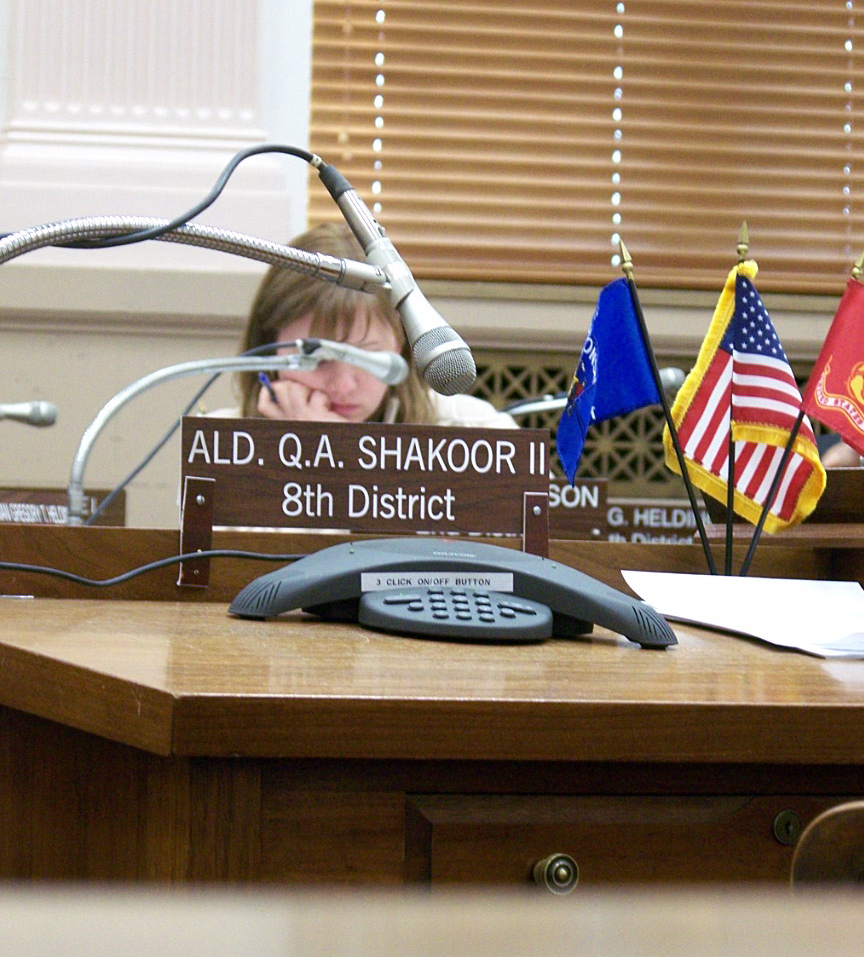
meeting Monday by speaker phone. City staff pointed the above microphone at
the speaker to amplify the developer's voice. The commission rejected the proposal.


UPDATE, Feb. 3: With no debate, the City Council voted 14-0 to accept yesterday's Planning Commission's recommendation, formally killing what Alderman Greg Helding called "the infamous West Racine project." In the public comment section of the council meeting, five citizens spoke against the project, and one presented another 200 signatures on a petition opposing it.

Original post:

The Plan Commission, at the urging of a grassroots neighborhood movement, knocked out a proposed $7 million affordable housing development proposed for West Racine.

The commission voted unanimously Monday afternoon to deny the 55-unit apartment complex, which included commercial development.

The North Carolina-based developer did little to help its case at Monday’s meeting when it failed to send a representative to the meeting. An employee chimed in on a conference call, but dodged a poignant question claiming only another employee could answer it. Not exactly helping out concerns that you’ll be absentee landlords, folks.

The proposal moves ahead to the City Council, but is likely DOA. Chalk one up for participatory democracy. Dozens of opponents packed a public hearing last week to oppose the project. They turned in a petition with over 200 names on it objecting to the low-income apartments, and swayed a commission that appeared to be leaning in favor of the proposal.

Not that this is good news for the city. The vote puts developers and planners back to square one on a piece of (supposedly) prime real estate in one of the city’s most prosperous neighborhoods. It also means a loss of about $150,000 in property taxes, which could go to paying down the $2 million in debt needed to demolish buildings for redevelopment.

Here’s a recap of the meeting:

4:04 p.m.
City Council President David Maack calls the meeting to order. It’s his last Plan Commission meeting. He’ll hand over the gavel to Tom Friedel after Tuesday night’s City Council meeting. Maack reminds the crowd of about 30 there’s no comment during the meeting. Roll Call: Four members are here, but no Judley Wyant.

4:05 p.m.

Matt Sadowski, of the city planning department, is trying to get the developer on speaker phone … and there she is. It’s an odd sight. One of the City Council microphones is pointed down at a speaker to amplify the developer’s voice. I think the company knows this is a lost cause.

4:07 p.m.

Alderman Greg Helding asks for city staff’s recommendation. Sawdoski reads it off … staff recommends approval. So that sets up the showdown: the city’s development professionals vs. a riled up group of West Racine residents.

Aldermen Aron Wisneski, Sandy Weidner, Bob Anderson, Robert Mozol and Jim Spangenberg are in attendance. So is County Supervisor Van Wangaard.

4:11 p.m.

Helding moves to deny the project’s conditional-use permit (the commission is actually voting on giving the developer a permit to build on the land). Crickets. No one seconds the motion.

4:11 p.m.

Plan Commission member Brent Oglesby has some questions for the developer. Oglesby was for the proposal at the last meeting. (Wyant walks in.)

Oglesby asks the developer to prove they can’t build a smaller development and still make money. He points out they’re not putting in any of their own cash, because they’re using state tax credits to fund the project.

The developer, Heather Hammond, hems and haws about the numbers and then says she wishes “Jim” was available, because he could explain it. But Jim’s not here, and the question goes unanswered.

Oglesby then wonders if the developer actually has the money they say they have. Here’s the deal: the state tax credits this year are worth a lot less than tax credits from previous years. Why? Because everyone is losing so much money there’s no need to invest in credits that are essentially a tax write-off. Essentially, real losses mean there’s no need for fake losses.

The developer says they have a national network of investors who will cover the project’s cost. Oglesby openly shakes his head in disbelief, which is funny because the developer can’t see him.

4:15 p.m.

Helding again moves to deny the request. He wants to say why, but he needs a second. Oglesby seconds, recluctantly.

Helding says the development is too dense and there’s not enough parking. He says parking is an issue, because West Racine may fill up one day and need a lot of parking. (It’ll be interesting to see how important parking is if a 55-unit condo or senior housing development is proposed for the same site.)

Helding adds there’s already too much rental housing in the city, and points out that residents seem pretty strongly opposed to this.

“We have these public hearings for a reason … they can’t just be symbolic,” he says.

4:17 p.m.

Commission member Elaine Ekes-Sutton is worried the development is too dense. She says the idea is good, there’s just too many apartments. She’ll vote no.

4:18 p.m.

Oglesby says he’ll vote no. That’s a change from last week. He encourages the developer to resubmit a smaller plan, saying the state may give out two or three rounds of WHEDA tax credits this year. “I would not take this as a death shot,” he said.

4:19 p.m.

Wyant asks: Is this the best the city can do, or will something better come along? He thinks something better will come along.

4:20 p.m.

It’s unanimous. The commission votes against the conditional-use permit. The City Council could overturn the commission’s decision Tuesday night, but it’s probably won’t. The project may not get a single vote.

4:21 p.m.

That’s it. We’re adjourned. You have to wonder if this project fares better if Mayor Becker was still around. I suspect he backed this project and wanted to get things moving in West Racine. After all, a vacant lot with $2+ million in debt isn’t exactly a help to the city budget. (It’s also worth noting high-quality low-income housing is needed in the city. There are thousands of hard-working families in the city who make between $23,000 and $43,000 a year who could use a decent place to raise children or just come home to.)

But Becker is gone, no one was willing to standup for the project, and now it’s kaput.

January 29, 2009

Alderman Tom Friedel named interim mayor

Alderman Tom Friedel at Thursday night's Committee of the Whole meeting.
See more photos from the meeting here.


Respected Alderman Tom Friedel will be the city's next mayor.

The City Council, meeting as the Committee of the Whole, voted unanimously Thursday night to appoint Friedel to the city's top office. He replaces Gary Becker, who resigned after getting arrested in an Internet sex sting.

Friedel was selected based on an obscure city ordinance that laid out a succession plan in the event of a war. The ordinance listed the City Council president as first in line, followed by the chairman of the Finance Committee, Public Works Committee and Public Safety Committee.

Alderman David Maack, who is council president, passed on serving as interim mayor because he would lose his council seat in the April election. Friedel, as chair of the Finance Committee, was next in line and agreed to serve. He also agreed not to run for mayor in the special election this spring, an important consideration for council members reluctant to give an edge to a candidate.

Council members widely praised Friedel for his skill and experience in handling city business.

After the meeting, Friedel said he would take an unpaid leave of absence from his job at Twin Disc while serving as interim mayor. He will be paid as mayor, and will earn roughly one-third of the mayor's $69,000 a year salary ($91,000 when you add in benefits) for his 3-4 months of work as the city's chief executive.

The council will finalize Friedel's appointment on Tuesday, the same night the council scheduled to vote on a proposed $7 million development in West Racine.

Friedel said Thursday night he was undecided on the development.

Here's how the meeting went down:

5:53 p.m.

No one is parking in the mayor’s parking spot tonight.

5:55 p.m.

TV is here tonight. Channel 4 is parked in the lot, and another guy is carrying around a big camera. The crowd is smaller than last night’s Plan Commission, but the full council is here, so the room is hopping.

5:57 p.m.

Jim Smith is here. So is First District candidate Mercedes Dzindzeleta, and former Alderman Bob Morrison, Police Chief Kurt Wahlen, Mayoral candidate Pete Karas, City Administrator Ben Hughes, and former Alderman Tom Sollman.

6 p.m.

David Maack calls the Committee of the Whole to order. The whole council is here, and everyone is in a bubbly mood. Jeff Coe hands out bottles of water. Sandy Weidner points out she just got her hair done.

6:03 p.m.

Maack clarifies the council will not vote on when to hold the special election to replace the mayor. They’re just here to select an interim mayor.

City Attorney Bob Weber lays out the situation. The council is looking for a full-time mayor who won’t run in the upcoming special election. They have three ways to go about picking the mayor:

1. Do nothing, which would violate state law.
2. Appoint a mayor until an election takes place.
3. Use an obscure provision in city code that lays out a succession order for the mayor’s office in the event of a war.

Weber says No. 3 would apply to Becker’s surprising resignation. “An indictment is not a war, but it’s certainly created an emergency,” he said.

The succession order is:

1. President of the City Council
2. Chair of the Finance Committee
3. Chair of the Public Works Committee
4. Chair of the Public Safety Committee

Here’s where it gets messy. Becker had the discourtesy of attempting to hook up with a 14-year-old for sex near the spring election, which makes picking his replacement a lot more complicated. Under the succession plan, Maack would be first in line for the mayor’s office. But he’s up for election in April, and would have to resign his council seat and skip the spring election. The council could reappoint him to the seat, but then he’d have to run for re-election in 2010 and 2011.

In other words, Maack, who wants to stay on the council, wants no part of the interim mayor position. So who’s next in line? Tom Friedel, who chairs the Finance Committee.

6:09 p.m.

Alderman Ron Hart is the first to wade into the debate. He wants to talk about saving $36,000 by moving the special election primary up to coincide with the general election in April. But he can’t talk about it, because it’s not on the agenda. He tries anyway and gets point-of-ordered into silence.

6:12 p.m.

Alderman Jim Kaplan belabors the point saying an agenda was sent out listing the special election issue as up for discussion. Nope, says Weber, that was an internal staff memo.

6:13 p.m.

Alderman/Mayor Candidate Jim Spangenberg wants to go down the list of succession and see who’s interested in the interim job. Friedel, Helding and Shakoor (the committee chairs) all say they’re eligible. Helding and Shakoor shrug, though. They think Friedel is the way to go.

6:15 p.m.

Alderman Aron Wisneski takes the lead. He says he talked with a bunch of people and every single person said, roughly: Did you set an election date? About the interim mayor, they said: We don’t care who it is. There should be one. Make a decision.

“Having an empty executive seat for 3-4 months is not going to benefit the city at a crucial time,” Wisneski said.

He then introduces the motion to appoint Friedel interim mayor. It’s immediately seconded.

6:18 p.m.

Hart asks if the city could save money and just stick with Maack as a stop-gap until the special election. Weber says, under state law, that’s probably not a good idea. Hart pushes the point. There’s not really a need for an interim mayor, he says, and they’ll just take up staff time learning all of the issues. Plus, Racine’s legislators will take care of the city’s share of the federal stimulus funds.

6:22 p.m.

Maack, who’s managing a long list of speakers, accidentally skips Alderman Mike Shields and calls on Alderman QA Shakoor II. Shields isn’t amused. “I yield to the alderman, but pay attention,” Shields says to Maack. Maack winces.

6:23 p.m.

Shakoor says succession is the way to go. It looks like Friedel will be the next mayor.

6:24 p.m.

Shields wants to know if Friedel is, or isn’t, going to run for mayor.

6:25 p.m.

Friedel makes a statement. He says the last two weeks have been painful, and he’s worked behind the scenes to get Becker to resign. After talking with family and his employer (Twin Disc), he decided it’s not the right time to run for mayor. “I have no intention of running this spring,” he said. (Note how Friedel didn’t rule out a future run for mayor. He’s eyeing 2011.)

6: 27 p.m.

Shields says he won’t mind Maack filling in as mayor. He points out Mayor Olson was sick for two months and the City Council president filled in fine.

6:28 p.m.

Alderman Bob Mozol wants to make sure the council is following the succession path. It is.

6:30 p.m.

Alderman Jim Kaplan speaks against the motion, but not why you think. He says the succession plan automatically makes Friedel interim mayor, so no need for a motion. In other words; What are we all doing here?

Weber says Kaplan is right, but the council needs to vote to follow the succession plan,

6:32 p.m.

Alderman ray DeHahn supports Friedel. He asks how much training Friedel will need.

6:33 p.m.

Friedel says not a lot. He’s served on the School Board and City Council for a long time. He knows the drill.

6:34 p.m.

Weidner backs Friedel. She says she was surprised at the passion residents had on the need for a mayor, and for holding a special election. She notes Friedel was elected to the council, and describes him as trustworthy and diplomatic.

6:36 p.m.

Alderman Jeff Coe says Maack did a good job as a fill-in mayor, and that he respects Friedel. But he’s worried appointing a someone on the council interim mayor will cause divisiveness.

6:37 p.m.

Alderman Greg Helding backs Friedel. He says the council isn’t rushing to a decision, it’s being decisive.

6:39 p.m.

Spangenberg says Maack is doing a good job, but the council needs to follow the law. The city would be in very good hands with Friedel, he says.

6:41 p.m.

Shields says Friedel would do a good job, but wonders about his council seat. If Friedel is named mayor, won’t he have to resign his council seat? And, wouldn’t the council appoint a replacement to fill out Friedel’s term, which runs through 2010?

For a moment, the love fest is broken. If Friedel is named interim mayor, the council will have to reappoint him to his seat once the new mayor is elected. In a sense, they’re making a deal to keep his seat vacant for 3-4 months.

Weber muddies the waters by saying the council can’t appoint a replacement. Helding points out the council has left vacancies in the past and had other aldermen cover the district.

Spangenberg adds if Friedel’s constituents are having a problem, they can call the mayor’s office.

6:45 p.m.

Alderman Terry McCarthy is good with Friedel and the succession plan.

6:46 p.m.

Mozol quips, “The way it sounds tonight, everyone is running for something.” He really wants to nail down that council followed the succession plan.

6:47 p.m.

Wisneski agrees to reword his ordinance.

6:48 p.m.

Hart speaks in favor of the motion. He still wants to save $36,000, and adds about Friedel: “I played ball against him years ago. He couldn’t catch, but he still played ball.”

6:49 p.m.

Weidner points out the motion goes to the council meeting on Tuesday. Weber says Friedel would be sworn in Tuesday.

6:50 p.m.

Kaplan backs Friedel. The love fest is officially back on. Except for the money. He really doesn’t want to hold two special elections.

6:50 p.m.

Maack thanks the council for saying nice things about him. He calls for a unanimous vote for Friedel. Weber clarifies the council could appoint a replacement for Friedel.

6:52 p.m.

Wisneski calls to question. Weidner is worried Friedel may lose his seat. She wants to know if the council will hold it open for him. Maack says the council can’t talk about it.

6:53 p.m.

Friedel says he’ll risk losing his seat. “It’s more important I serve as interim mayor than alderman of the 10th District,” he says.

6:54 p.m.

Spangenberg points out Friedel is going to hear from his constituents as interim mayor.

6:55 p.m.

It’s unanimous for Friedel. Crowd applauds.

6:56 p.m.

Meeting adjourned.