Two city agencies may lose tens of thousands of dollars after reaching an impasse over how to spend the money.
Alderman Greg Helding put in two communications for Monday's City Council meeting to take $30,000 from the Racine Public Library's budget and $40,000 from the city's cable-access TV budget. Both the library and CAR25 have failed to spend the money despite support from the City Council and mayor to do so.
Mayor John Dickert wanted to spend $40,000 to hire an internationally renown TV journalist to revamp the station. Dickert's plans were thwarted by the station's board and eventually by the City Council. Despite the consultant's credentials, the mayor was criticized because he didn't take bids for the job and was friends with person he recommended for the contract.
The council voted last fall to give the library an additional $33,000 to open on Sundays during the school year, but five months later the library has yet to add the hours. The issue now appears dead. The library just reached a contract with a union that did not include Sunday hours, and it appears the Library Board is reluctant to reconsider the issue.
Helding's communication requests transferring the $40,000 from CAR25's professional services account to the city's "Judgement and Claims" account, which took a hit earlier this year when the city agreed to pay Sandra Tingle $50,000 to settle her case sexual harassment claim.
As for the library money, Helding wants to move $30,000 of the funding to the city's "Contingency" account, which is typically used for unexpected expenses. The money could also be carried over into the 2011 budget, which is already looking tight.

Showing posts with label Greg Helding. Show all posts
Showing posts with label Greg Helding. Show all posts
April 18, 2010


March 16, 2010
McCarthy, Helding consider changes to purchasing ordinance
Aldermen Terry McCarthy and Greg Helding are considering changes to the city's policy for purchases over $25,000.
The aldermen have a communication on tonight's City Council agenda to discuss the city's Purchasing Ordinance (see below).
City ordinance requires departments to request bids for contracts over $25,000, unless contracts are for "professional services." This is relevant now because the proposed $40,000 to hire a consultant for CAR25, the city's cable-access TV station, fell under the professional services clause and was not required to go out for bid.
McCarthy asked City Administrator Tom Friedel last month to review the city's policy on bidding out contracts and to consider dropping the exception for professional services.
Here's the ordinance in question (emphasis added):
The aldermen have a communication on tonight's City Council agenda to discuss the city's Purchasing Ordinance (see below).
City ordinance requires departments to request bids for contracts over $25,000, unless contracts are for "professional services." This is relevant now because the proposed $40,000 to hire a consultant for CAR25, the city's cable-access TV station, fell under the professional services clause and was not required to go out for bid.
McCarthy asked City Administrator Tom Friedel last month to review the city's policy on bidding out contracts and to consider dropping the exception for professional services.
Here's the ordinance in question (emphasis added):
Sec. 46-28. Purchases over $25,000.00; advertising for bids.
(a) Bids shall be required for every purchase of materials, supplies, equipment or contractual services, excepting professional services, the estimated cost of which exceeds $25,000.00. Bids shall be advertised for in the manner provided in Wis. Stats. § 62.15, except that the notice shall be published not less than twice and bids shall be received not less than ten days after first publication. Advertisement for bids shall not be required for any purchase, the estimated cost of which does not exceed $25,000.00, but in such case the purchasing agent shall secure and record at least three informal bids, if practicable.
If the estimated cost of public construction exceeds $5,000.00 but is not greater than $25,000.00, the purchasing agent shall publish one notice of the proposed construction before a contract for the construction is executed. This provision does not apply to public construction if the materials for such a project are donated or if the labor for such a project is provided by volunteers.
The common council may, by resolution, dispense with the requirement of advertising for bids in any particular case.
(b) A summary of the bids received for each item listing the name of each bidder and a copy of his bid shall be submitted to the appropriate committee of the common council for its recommendation to the common council. The adoption of the committee report by the common council shall constitute the final action of the council upon the bids and shall authorize the purchasing agent to issue a purchase order, countersigned by the finance director as to availability of funds, for the purchase of the items on which such bids were received.
(Code 1973, § 3.18.040; Ord. No. 1-91, pt. 2, 1-15-91; Ord. No. 1-00, pts. 2, 3, 3-7-00; Ord. No. 50-04, pt. 1, 1-18-05; Ord. No. 13-06, pt. 2, 5-24-06)
January 12, 2010
As city thinks about limiting new bars, a committee splits on how many bars Racine should have
One alderman's attempt to limit the proliferation of bars in Racine is headed for a showdown before the City Council.
At issue are the number of Class B liquor licenses the city issues, and how much applicants have to pay for one of the licenses.
Alderman Greg Helding wants to make it more expensive to get a Class B liquor license - the one needed to run a bar or a restaurant with a bar - if the license exceeds the state-set quota on liquor licenses in the city.
OK, that's a mouthful. Let's break it down.
State law says Racine can give out 128 Class B liquor licenses and 22 "reserve" Class B liquor licenses. So what does that mean? There's two ways to see it:
1.) The city has a limit of 128 liquor licenses. The 22 "reserve" licenses are special and should be treated as such.
2.) The city has 150 Class B liquor licenses. There's no difference between regular and reserve licenses.
(There's actually a third option: The city could set a limit on its Class B licenses lower than the state-set limit, which is based on population. This may be the direction is headed this year.)
Right now, the city follows option No. 2. Racine has given out all of its regular licenses, and is now issuing reserve licenses. There is a $10,000 fee to get a reserve license, but the city refunds $9,500 of the fee, meaning the reserve license costs the same as a regular liquor license. (The city also doesn't treat reserve liquor license applications any different from regular applications. The only difference between the two is you need $10,000 upfront with the understanding most of the money will be returned.)
OK, this all sets up Monday night's Public Safety and Licensing Committee meeting. Helding proposed eliminating the $9,500 refund for the reserve licenses. The city is allowed to do so under state law, Helding said, and it would create a special, more expensive tier for Class B liquor licenses. In essence, it would be aligning the city option No. 1 above: the city has 128 liquor licenses, and if someone wants to exceed that number, it's going to cost them.
Helding's proposal ran into opposition. Aldermen Bob Mozol and Jim Kaplan voted against the measure saying it could cost new businesses, like a restaurant, too much money to get started.
"That $9,500 could be another piece of equipment in the kitchen," Kaplan said.
Aldermen Sandy Weidner and Aron Wisneski voted in favor of the proposal, but it still failed on a 2-2 vote. Alderman David Maack, who sits on the committee, was not in attendance.
The committee then voted unanimously to "receive and file" Helding's proposal, which heads to next week's City Council without the Public Safety and Licensing Committee's support. But that doesn't mean the proposal is dead.
It now heads to the full City Council, which can vote to override the committee's vote. Helding said Monday night he's not sure if he'll push for the council to consider his proposal or regroup and consider other ways to limit Class B liquor licenses in Racine, such as making it more difficult to exceed a locally set quota on Class B liquor licenses.
At issue are the number of Class B liquor licenses the city issues, and how much applicants have to pay for one of the licenses.
Alderman Greg Helding wants to make it more expensive to get a Class B liquor license - the one needed to run a bar or a restaurant with a bar - if the license exceeds the state-set quota on liquor licenses in the city.
OK, that's a mouthful. Let's break it down.
State law says Racine can give out 128 Class B liquor licenses and 22 "reserve" Class B liquor licenses. So what does that mean? There's two ways to see it:
1.) The city has a limit of 128 liquor licenses. The 22 "reserve" licenses are special and should be treated as such.
2.) The city has 150 Class B liquor licenses. There's no difference between regular and reserve licenses.
(There's actually a third option: The city could set a limit on its Class B licenses lower than the state-set limit, which is based on population. This may be the direction is headed this year.)
Right now, the city follows option No. 2. Racine has given out all of its regular licenses, and is now issuing reserve licenses. There is a $10,000 fee to get a reserve license, but the city refunds $9,500 of the fee, meaning the reserve license costs the same as a regular liquor license. (The city also doesn't treat reserve liquor license applications any different from regular applications. The only difference between the two is you need $10,000 upfront with the understanding most of the money will be returned.)
OK, this all sets up Monday night's Public Safety and Licensing Committee meeting. Helding proposed eliminating the $9,500 refund for the reserve licenses. The city is allowed to do so under state law, Helding said, and it would create a special, more expensive tier for Class B liquor licenses. In essence, it would be aligning the city option No. 1 above: the city has 128 liquor licenses, and if someone wants to exceed that number, it's going to cost them.
Helding's proposal ran into opposition. Aldermen Bob Mozol and Jim Kaplan voted against the measure saying it could cost new businesses, like a restaurant, too much money to get started.
"That $9,500 could be another piece of equipment in the kitchen," Kaplan said.
Aldermen Sandy Weidner and Aron Wisneski voted in favor of the proposal, but it still failed on a 2-2 vote. Alderman David Maack, who sits on the committee, was not in attendance.
The committee then voted unanimously to "receive and file" Helding's proposal, which heads to next week's City Council without the Public Safety and Licensing Committee's support. But that doesn't mean the proposal is dead.
It now heads to the full City Council, which can vote to override the committee's vote. Helding said Monday night he's not sure if he'll push for the council to consider his proposal or regroup and consider other ways to limit Class B liquor licenses in Racine, such as making it more difficult to exceed a locally set quota on Class B liquor licenses.
January 5, 2010
Sign exemption questioned for Uptown car dealer
The City Council will vote tonight on whether to allow a used car dealer in Uptown to use a sign that doesn't fit with the area's design guidelines.
Servantez Automotive Inc., 1407 S. Memorial Drive, is seeking permission for a changeable sign to advertise cars and prices, and for inspirational messages. At least one alderman is planning to object to the exemption.
Alderman Greg Helding contends the city should follow the design guidelines created for special districts. Otherwise, he asks, what's the point?
But his objections stand against a city committee charged with reviewing the Uptown design guidelines. The Access Corridor Development Review Committee agreed to grant Servantez Automotive the sign exemption at its Dec. 17 meeting.
Helding said the city had already made an exemption to allow the used car dealer to open in an historic building in Uptown. It shouldn't allow another exemption, even if it is just for a sign.
The council is set to vote on the Servantez sign exemption tonight.
Update: The exemption passed the City Council Tuesday night. Helding voted against the exemption, but didn't raise much debate on the issue.
October 16, 2009
HALO, shut out of city funding, may get another chance at CDBG money
The city's Community Development Block Grant committee will reconsider its decision to deny money to Racine's primary homeless shelter.
The Community Development Committee voted on Oct. 8 to deny HALO's entire request. The shelter had received at least $50,000 in CDBG funding the last three years.
Alderman Greg Helding, who sits on the committee, said Friday he wanted to take another look at HALO's $76,194 request to run its shelters. Helding voted against money for the homeless shelter, but he's since reconsidered his decision.
CDBG money is given out by the federal government to help communities pay for local projects and programs. Helding said the money should be given out based on community priorities, and based on that criteria, HALO was a worthy recipient.
Others on the committee argued the Community Development Committee should consider new programs this year instead of acting out of habit. Ken Lumpkin, who sits on the committee, said all organizations should be eligible for the money.
"There shouldn't be any sacred cows," Lumpkin said. "No organization should be automatic."
The decision on HALO came, in part, because the city received $1.4 million in requests for about $315,000 in CDBG money. Lumpkin said deciding among projects is near impossible because most organizations who apply are doing important work in the community.
"Homelessness is an issue, but joblessness is an issue. So are youths being steered away from gangs," Lumpkin said.
The committee's decision on HALO was surprising because the organization received $50,400 in CDBG funding in 2007, $55,000 in 2008 and $50,000 in 2009. The shelter requested $76,194 for 2010.
The decision drew a strong rebuke from Neal Nottleson, who sits on the shelter's board of directors. Nottleson wrote to community members:
The committee's next meeting is Oct. 21.
The Community Development Committee voted on Oct. 8 to deny HALO's entire request. The shelter had received at least $50,000 in CDBG funding the last three years.
Alderman Greg Helding, who sits on the committee, said Friday he wanted to take another look at HALO's $76,194 request to run its shelters. Helding voted against money for the homeless shelter, but he's since reconsidered his decision.
CDBG money is given out by the federal government to help communities pay for local projects and programs. Helding said the money should be given out based on community priorities, and based on that criteria, HALO was a worthy recipient.
Others on the committee argued the Community Development Committee should consider new programs this year instead of acting out of habit. Ken Lumpkin, who sits on the committee, said all organizations should be eligible for the money.
"There shouldn't be any sacred cows," Lumpkin said. "No organization should be automatic."
The decision on HALO came, in part, because the city received $1.4 million in requests for about $315,000 in CDBG money. Lumpkin said deciding among projects is near impossible because most organizations who apply are doing important work in the community.
"Homelessness is an issue, but joblessness is an issue. So are youths being steered away from gangs," Lumpkin said.
The committee's decision on HALO was surprising because the organization received $50,400 in CDBG funding in 2007, $55,000 in 2008 and $50,000 in 2009. The shelter requested $76,194 for 2010.
The decision drew a strong rebuke from Neal Nottleson, who sits on the shelter's board of directors. Nottleson wrote to community members:
... I could translate the decision to exclude the decision to exclude HALO from ANY CDBG funding for 2010 (after being the recipient of $50,000 this year) as, in effect saying "... we've now resolved the homeless issue; let's move on to other things...". Obviously, nothing could be further from the truth and I don't really believe you think that to be the case, but that's how it could appear.Nottleson urged the committee to reconsider its decision, and he'll likely get his wish. Helding said the committee's recommendations at the Oct. 8 meeting were preliminary and that he'll ask to reconsider the HALO decision.
The committee's next meeting is Oct. 21.
May 29, 2009
Committee approves $350,000 for LED street lights; Stimulus money could help city balance budget
 It was a good night for Family Services of Racine Executive Director Katie Oatsvall.
She secured $50,000 in stimulus money to make her organization's building handicap accessible.
The city hopes to turn $350,000 in federal stimulus money into $700,000 in savings by replacing street lights with LED fixtures.
The seemingly mundane approval could have a big effect on the city’s bottom line. LED street lights are 45-49 percent more efficient than the We Energies fixtures throughout the city. The $350,000, plus another $300,000 in stimulus money from another source, is expected to replace about 1,300 street lights throughout the city.
The energy savings will come at a critical time. Racine is facing massive cuts in state shared revenue and unexpected bills from the state, according to city officials. In all, the city could be looking at a $1.5 million budget gap next year – a huge amount to overcome.
LED lights should help. The Community Development Committee voted to spend the $350,000 on the new lights Thursday night. The amount was actually cut by $50,000 to give Family Services of Racine money to create a handicap accessible entrance to their building.
In both cases, committee members were swayed by the direct impact the spending would have on the local economy. The LED lights would employ local electricians for several months and help the city’s bottom line in the end. The Family Services project would employ local contractors for two months and help the nonprofit serve its clients better in the future.
 Claudius Adebayo, executive director of OIC of Racine County, couldn't convince the committee to give his organization $10,000 to study moving into a new building.
 The committee also approved spending $72,500 to join the county’s Green Summer Jobs grant and $7,500 to the Urban League of Racine and Kenosha to help local residents seeking jobs to brush up on math skills to pass employment tests.
The green jobs programs will train 200 14- to 24-year-olds for jobs like community gardening, distributing high-energy light bulbs and replacing windows in homes. The Workforce Development Center put up $450,000 for the program, which will run June 22 to Aug. 14.
The committee’s votes Thursday came after lengthy consideration of eight proposals for use of $534,800 in stimulus money given to the city. The city’s two requests – for LED lights and the green jobs program - took up the bulk of the money. Committee members actually amended the city’s request to include the Urban League and Family Services requests.
Alderman Sandy Weidner also made a motion to give $4,000 to the Racine Literacy Council to work with people at the Workforce Development Center. Her proposal was voted down 8-3.
Weidner's proposal to give $7,500 to the Urban League passed 8-3. Yolanda Adams, president and CEO of the organization, said dozens of potential workers need a math refresher course to pass employment tests. "So many people can do the work, they just need to pass this test," she said.
Alderman David Maack proposed giving the $50,000 to Family Services. It was slightly less than the $55,000 requested by the organization, but Family Services Executive Director Katie Oatsvall said the small gap wouldn't be a problem.
In summary, the committee recommended spending $350,000 on LED streetlights, $72,500 on the green jobs program, $50,000 on Family Services handicap accessibility project and $7,500 on the Urban League's math refresher program. The CDBG money also allows for 10 percent of the funds ($53,480) to go toward program administration such as making copies, filling out paperwork.
Other proposals by Project New Life, the YMCA, Southgate Lodge No. 6 and OIC of Racine County were not given money.

The YMCA’s proposal was hurt because the written plan never made it to city staff. CEO Jeff Collen laid out a $30,500 plan to conserve energy at the building, but the proposal didn’t get much reaction from the committee. (Right: Joe Heck and Jeff Collen talk about what happened to the YMCA's request for the money.)
Collen did share the YMCA is hoping to sell its Racine building, move into another Downtown space and build a new building west of the city. When asked when the Y would like to sell its building, Collen replied: “Now, if we could.”
Debate on the CDBG stimulus money got a little heated. Alderman Aron Wisneski questioned why the city’s two proposals happened to exactly total the amount of the grant. He wanted community organizations to have a chance at the money.
Alderman Greg Helding spoke against the Family Services proposal, noting that giving $50,000 to the group cost the city $100,000 in energy savings. But when it came time to vote, Helding supported the Family Services request, which passed 8-3.
The final proposal passed the committee unanimously. It now goes to the full City Council on Tuesday. Joe Heck, assistant director of development for the city, has to get the proposal sent to the federal government by June 5.
May 6, 2009
Notes from the post-election parties ...
We were out at the post-election parties last night. Here's a few observations:
* Bob Turner was classy in defeat. He called the Dickert campaign and offered congratulations, and said he'd work for Racine in the Assembly. "If Racine wins, I win," Turner said.
* Not surprisingly, his party at Park 6 on Sixth Street was subdued. Alderman Michael Shields, Mayor Tom Friedel, Bev Hicks, Jameel Ghuari, Jim Spoddick (who owns the Park 6 building) and Pete Karas were all there when I got there at 9 p.m. WRJN's Jan Hoff was covering the party live.
* It was another rough night for Karas, who's been campaigning non-stop for several months. He helped a candidate in New Orleans run for Congress and a state superintendent candidate, then ran his own campaign for mayor and finally threw in for Turner in the last month. While a little disheartened (he lost all of the races) Karas promised he had more plans in the works.
* Friedel, who will step down as mayor in two weeks, said in an interview that he wasn't personally conflicted by the special election. He said he knew he was serving in interim role and looked forward to returning to the City Council.
But he also said there were a few times during the candidate forums when he got the itch to jump into the race. "Listening to the candidates, I thought a few times, 'I have better answers than these,'" Friedel admitted.
But he wouldn't touch the idea of whether he planned to run for mayor in 2011. "I'm not going there," Friedel said.
* On policy, Mayor Dickert will face an immediate challenge with the budget, Friedel said. The state may cut shared revenue this year, which would force the city to cut spending.
He added the big difference between being mayor and being an alderman was the broad scope of items that come across the mayor's desk. "It can be anything from honorariums to life-and-death issues and everything in between," Friedel said.
"The mayor serves everyone every day," he said.
* The Dickert party was - surprise, surprise - lively. Hundreds of people packed Salute's on Main Street to congratulate (and, in a few cases, suck up) to the new mayor.
* Frank and Sandra Tingle attended Dickert's party. Frank boasted that he traveled the greatest distance - 4,000 mile from London - to vote for Dickert.
* Here's a question: Now that Dickert is mayor, will Tingle's lawsuit against the city go away?
* Community for Change leaders were at Salute and talked about their next project: a communitywide forum on health care reform this summer before Congress votes on the issue. Organizers are hoping to put together a nonpartisan forum to discuss the issue and call for needed reforms. U.S. Rep. Paul Ryan and other big-name politicians will be on the invitee list.
* Aldermen Terry McCarthy is now, officially, a Canadian citizen. He received his dual citizenship on April 27.
* City Council members McCarthy, Jeff Coe, Aron Wisneski, Greg Helding and David Maack were all at the party.
* Bob Turner was classy in defeat. He called the Dickert campaign and offered congratulations, and said he'd work for Racine in the Assembly. "If Racine wins, I win," Turner said.
* Not surprisingly, his party at Park 6 on Sixth Street was subdued. Alderman Michael Shields, Mayor Tom Friedel, Bev Hicks, Jameel Ghuari, Jim Spoddick (who owns the Park 6 building) and Pete Karas were all there when I got there at 9 p.m. WRJN's Jan Hoff was covering the party live.
* It was another rough night for Karas, who's been campaigning non-stop for several months. He helped a candidate in New Orleans run for Congress and a state superintendent candidate, then ran his own campaign for mayor and finally threw in for Turner in the last month. While a little disheartened (he lost all of the races) Karas promised he had more plans in the works.
* Friedel, who will step down as mayor in two weeks, said in an interview that he wasn't personally conflicted by the special election. He said he knew he was serving in interim role and looked forward to returning to the City Council.
But he also said there were a few times during the candidate forums when he got the itch to jump into the race. "Listening to the candidates, I thought a few times, 'I have better answers than these,'" Friedel admitted.
But he wouldn't touch the idea of whether he planned to run for mayor in 2011. "I'm not going there," Friedel said.
* On policy, Mayor Dickert will face an immediate challenge with the budget, Friedel said. The state may cut shared revenue this year, which would force the city to cut spending.
He added the big difference between being mayor and being an alderman was the broad scope of items that come across the mayor's desk. "It can be anything from honorariums to life-and-death issues and everything in between," Friedel said.
"The mayor serves everyone every day," he said.
* The Dickert party was - surprise, surprise - lively. Hundreds of people packed Salute's on Main Street to congratulate (and, in a few cases, suck up) to the new mayor.
* Frank and Sandra Tingle attended Dickert's party. Frank boasted that he traveled the greatest distance - 4,000 mile from London - to vote for Dickert.
* Here's a question: Now that Dickert is mayor, will Tingle's lawsuit against the city go away?
* Community for Change leaders were at Salute and talked about their next project: a communitywide forum on health care reform this summer before Congress votes on the issue. Organizers are hoping to put together a nonpartisan forum to discuss the issue and call for needed reforms. U.S. Rep. Paul Ryan and other big-name politicians will be on the invitee list.
* Aldermen Terry McCarthy is now, officially, a Canadian citizen. He received his dual citizenship on April 27.
* City Council members McCarthy, Jeff Coe, Aron Wisneski, Greg Helding and David Maack were all at the party.
April 30, 2009
Helding endorses Dickert for mayor
Alderman Greg Helding endorsed John Dickert for mayor on Thursday. A mayoral candidate himself, Helding said he owed it to his supporters to choose between Dickert and Bob Turner before the May 5 special election.
Here's the letter Helding wrote explaining his position:
Here's the letter Helding wrote explaining his position:
Racine has an important decision to make on May 5. As an Alderman and former mayoral candidate, I just can’t “sit this one out”. I owe it to my supporters and the citizens of Racine to get off the fence. I am endorsing John Dickert for Mayor of Racine.
I believe that we the people of Racine should choose our next Mayor and not have the choice dictated to us by the power brokers in Madison. I don’t have the backing of well-financed labor unions and I don’t have influence with people in the backrooms of the Capitol. I’m just a voice for Racine encouraging everyone who voted for me in the primary to cast their general election ballot for John Dickert.
Racine is facing some real challenges and we have a lot of work to do. Racine needs someone at the helm who is dedicated to being Mayor. We need someone who is ready to start working for us now, not in September when the state budget is completed. On May 5, please vote John Dickert for Mayor.
Greg Helding
11th District Alderman
March 4, 2009
Helding turns in official papers; first candidate to collect needed signatures
Alderman Greg Helding won the race to be the first to enter the race. Helding officially filed his papers to run in the April 7 mayoral primary. The official papers require between 200 and 400 signatures.
Helding also announced his official website. Here's his full press release:
Helding also announced his official website. Here's his full press release:
Alderman Greg Helding Monday became the first candidate to file official papers to declare as a candidate for Mayor of Racine. Helding, who led all candidates in recent WRJN online polls, is running on a platform of reform after the forced resignation of Racine’s former mayor.
"Out of every terrible situation, we all have an opportunity to use this as a chance to make dramatic improvements," said Helding. “We must make changes right now to make this city a better place. This appalling incident should be all the motivation we need to take some bold steps forward as a city. I believe the citizens of Racine agree and I think that is why I have had such overwhelming support in the polls."
Helding filed more than the legally required number of signatures, and has more coming in the next few days.
"People want to see a change right now," said Helding. "That is why I found it so easy to collect these signatures. They are responding to my plans to deal forcefully with gangs and drug dealers that are ruining our quality of life. We cannot tolerate it any longer. Teachers, parents and businesspeople have told me that our schools are not getting the support that they need. They want a Mayor to lead on education, not blame others. Our city and our schools must improve together."
"Sadly, child sexual predators are still menace to our city," said Helding. "My previous attempts to deal with this problem were blocked. We have not taken the simple steps other cities have taken to protect ourselves. People want me to take action and I will."
Helding also announced the launch of his website, www.heldingformayor.com, where voters can read about his plans for Racine and keep in touch with the campaign.
"This is the end of something terrible and can be the beginning of something tremendous. That is what my campaign for Mayor is all about," said Helding.
February 2, 2009
West Racine thwarts low-income housing project
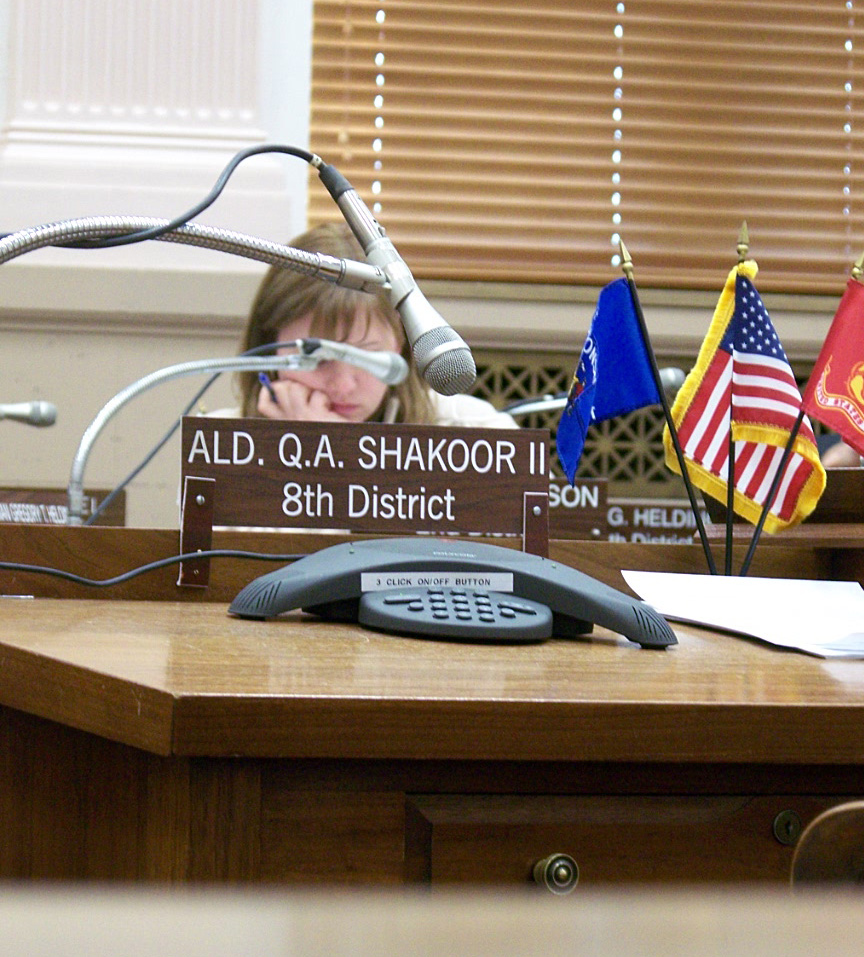 The developer of a proposed $7 million low-income housing project appeared at a key
meeting Monday by speaker phone. City staff pointed the above microphone at
the speaker to amplify the developer's voice. The commission rejected the proposal.
UPDATE, Feb. 3: With no debate, the City Council voted 14-0 to accept yesterday's Planning Commission's recommendation, formally killing what Alderman Greg Helding called "the infamous West Racine project." In the public comment section of the council meeting, five citizens spoke against the project, and one presented another 200 signatures on a petition opposing it.
Original post:
The Plan Commission, at the urging of a grassroots neighborhood movement, knocked out a proposed $7 million affordable housing development proposed for West Racine.
The commission voted unanimously Monday afternoon to deny the 55-unit apartment complex, which included commercial development.
The North Carolina-based developer did little to help its case at Monday’s meeting when it failed to send a representative to the meeting. An employee chimed in on a conference call, but dodged a poignant question claiming only another employee could answer it. Not exactly helping out concerns that you’ll be absentee landlords, folks.
The proposal moves ahead to the City Council, but is likely DOA. Chalk one up for participatory democracy. Dozens of opponents packed a public hearing last week to oppose the project. They turned in a petition with over 200 names on it objecting to the low-income apartments, and swayed a commission that appeared to be leaning in favor of the proposal.
Not that this is good news for the city. The vote puts developers and planners back to square one on a piece of (supposedly) prime real estate in one of the city’s most prosperous neighborhoods. It also means a loss of about $150,000 in property taxes, which could go to paying down the $2 million in debt needed to demolish buildings for redevelopment.
Here’s a recap of the meeting:
4:04 p.m.
City Council President David Maack calls the meeting to order. It’s his last Plan Commission meeting. He’ll hand over the gavel to Tom Friedel after Tuesday night’s City Council meeting. Maack reminds the crowd of about 30 there’s no comment during the meeting. Roll Call: Four members are here, but no Judley Wyant.
4:05 p.m.
Matt Sadowski, of the city planning department, is trying to get the developer on speaker phone … and there she is. It’s an odd sight. One of the City Council microphones is pointed down at a speaker to amplify the developer’s voice. I think the company knows this is a lost cause.
4:07 p.m.
Alderman Greg Helding asks for city staff’s recommendation. Sawdoski reads it off … staff recommends approval. So that sets up the showdown: the city’s development professionals vs. a riled up group of West Racine residents.
Aldermen Aron Wisneski, Sandy Weidner, Bob Anderson, Robert Mozol and Jim Spangenberg are in attendance. So is County Supervisor Van Wangaard.
4:11 p.m.
Helding moves to deny the project’s conditional-use permit (the commission is actually voting on giving the developer a permit to build on the land). Crickets. No one seconds the motion.
4:11 p.m.
Plan Commission member Brent Oglesby has some questions for the developer. Oglesby was for the proposal at the last meeting. (Wyant walks in.)
Oglesby asks the developer to prove they can’t build a smaller development and still make money. He points out they’re not putting in any of their own cash, because they’re using state tax credits to fund the project.
The developer, Heather Hammond, hems and haws about the numbers and then says she wishes “Jim” was available, because he could explain it. But Jim’s not here, and the question goes unanswered.
Oglesby then wonders if the developer actually has the money they say they have. Here’s the deal: the state tax credits this year are worth a lot less than tax credits from previous years. Why? Because everyone is losing so much money there’s no need to invest in credits that are essentially a tax write-off. Essentially, real losses mean there’s no need for fake losses.
The developer says they have a national network of investors who will cover the project’s cost. Oglesby openly shakes his head in disbelief, which is funny because the developer can’t see him.
4:15 p.m.
Helding again moves to deny the request. He wants to say why, but he needs a second. Oglesby seconds, recluctantly.
Helding says the development is too dense and there’s not enough parking. He says parking is an issue, because West Racine may fill up one day and need a lot of parking. (It’ll be interesting to see how important parking is if a 55-unit condo or senior housing development is proposed for the same site.)
Helding adds there’s already too much rental housing in the city, and points out that residents seem pretty strongly opposed to this.
“We have these public hearings for a reason … they can’t just be symbolic,” he says.
4:17 p.m.
Commission member Elaine Ekes-Sutton is worried the development is too dense. She says the idea is good, there’s just too many apartments. She’ll vote no.
4:18 p.m.
Oglesby says he’ll vote no. That’s a change from last week. He encourages the developer to resubmit a smaller plan, saying the state may give out two or three rounds of WHEDA tax credits this year. “I would not take this as a death shot,” he said.
4:19 p.m.
Wyant asks: Is this the best the city can do, or will something better come along? He thinks something better will come along.
4:20 p.m.
It’s unanimous. The commission votes against the conditional-use permit. The City Council could overturn the commission’s decision Tuesday night, but it’s probably won’t. The project may not get a single vote.
4:21 p.m.
That’s it. We’re adjourned. You have to wonder if this project fares better if Mayor Becker was still around. I suspect he backed this project and wanted to get things moving in West Racine. After all, a vacant lot with $2+ million in debt isn’t exactly a help to the city budget. (It’s also worth noting high-quality low-income housing is needed in the city. There are thousands of hard-working families in the city who make between $23,000 and $43,000 a year who could use a decent place to raise children or just come home to.)
But Becker is gone, no one was willing to standup for the project, and now it’s kaput.
January 28, 2009
West Racine residents rally against low-income housing development
The City Plan Commission voted Wednesday evening to put off a decision on a 55-unit affordable housing development in West Racine at Washington Avenue and West Boulevard. Here’s a blow-by-blow account of a contentious public hearing at the commission’s meeting:
4:08 p.m.
Someone is parking in the “Reserved for Mayor” parking spot outside of City Hall. It’s curious, because we don’t have a mayor. It’s not even fill-in mayor David Maack’s car. Hmm …
4:18 p.m.
David Maack calls Plan Commission to order. About 60 people are in the crowd. More are trickling in.
4:19 p.m.
The commission votes to go into closed session to consult with legal counsel. They retreat to the mayor’s office to meet. The crowd is up to at least 80 people.
4:32 p.m.
The commission returns and votes to table some sort of request involving the establishment of an outlet at 4700 Washington Ave. They just want to plug in a lamp! (Oh, not that kind of outlet.)
4:36 p.m.
An ordinance involving historical guidelines is passed, but it needs more approvals. Alderman/Mayor candidate Greg Helding upsets PETA by saying; “There’s more kicks at the cat, so to speak, before it’s done.”
4:39 p.m.
Malek Musaitef wants to open a daycare center at 1630 Douglas Avenue. Seems pretty straight forward, and the commission approves the permit. Oops, I typed too quickly. Commission member Elaine Sutton-Ekes amends the proposal – something about landscaping – but the commission still approves it unanimously.
4:44 p.m.
The Commission rolls on with business while a standing-room only crowd waits for the public hearing, which was scheduled to begin at 4:30 p.m. Couldn’t the commission have gone into closed session after the public hearing?
4:45 p.m.
Now they’re talking about a procedural change that affects few, if any, people. It passes.
4:46 p.m.
Public hearing is underway … let’s get it on! Maack lays out the rules, and then tells the group the Commission will lose its quorum at 6:15 p.m. How’s that for public servants! (And, no, apparently they couldn’t put off that closed session.)
4:48 p.m.
Quick overview of the proposal. It seems like a decent development, but a lot of people are opposed. We’re about to find out why.
4:49 p.m.
More slides. It is a pleasant-looking development for the corner of Washington and West Boulevard. Three-story buildings with stores on the first floor and apartments above.
4:50 p.m.
There are two more buildings between Grove Avenue and West Boulevard that are a little more imposing. Hardly offensive, though. Or aren’t they?
4:51 p.m.
We’re looking at 66,646 square-feet on 27 percent of the available space. The development could be four times bigger under city ordinance.
4:52 p.m.
That’s a problem. Ordinance only allows for 27 units above the first floor, and the developers want 55 units. It also requires 129 parking spots. First rule in fighting a development: challenge the parking.
4:53 p.m.
Heather Hammond, from Landmark Development, the North Carolina company that hopes to the build the $7 million project, is up. She says people making between $28,000 and $43,000 will be able to live in the apartments, which include new appliances, balconies, pre-wired for cable, ceiling fans, A/C, etc. Rents range from $500 for a 1-bedroom to $700 for three-bedroom, which she says is a good price for hard-working people.
Hammond adds the neighborhood has a bunch of old houses, and it could use some new construction. Landmark is the group to do it, because it has an award-winning track record on property management.
In short, the company will take care of the property because it wants to make money. It’s also scaled back the development from 73 units to 55 units, but can’t go any smaller and come out ahead. They also can’t add more than 83 parking spaces, and they need approval quick because of a Feb. 16 deadline for state (WHEDA) tax credits.
“Our plan will bring life back into the block,” Hammond said, pointing out it’s now a gravel lot.
5:00 p.m.
Brian O’Connell is up. He backs the project, saying it’s the culmination of four years of work on the part of the city’s Redevelopment Authority. He goes through the timeline of what it took to knock down old buildings to make way for new development on the site.
5:01 p.m.
The crowd is near 100.
5:02 p.m.
O’Connell is defending Landmark. He’s happy with their plan, and wants it passed.
5:03 p.m.
Here comes the public comment portion of the public hearing. Maack reminds the standing-room crowd that the commission will lose quorum at 6:15 p.m. Commission member Judley Wyant isn’t in attendance tonight. I’m not sure who else has to leave.
5:04 p.m.
First speaker comes out in favor of the proposal. He wants to confront rising crime in the area with new development. He says Landmark is a good manager who won’t allow the property to spin out of control.
5:07 p.m.
Greg Thompson, of Bukacek Construction, supports the project. He points out it’s been a rough year on the construction industry. Bukacek has laid off employees, and their backlog is 50 to 75 percent below what it was last year. He points out Landmark is taking a $7 million risk on West Racine. The company will protect its investment.
5:10 p.m.
The commission didn’t set a time limit on speakers. It’s hard to know if Maack forgot, or if there is no time limit on public hearings. With the 6:15 p.m. deadline looming, could we see a filibuster?
5:11 p.m.
Maack asks the audience not to talk during the hearing.
5:11 p.m
Lawrence Gray, a West Racine resident, speaks in favor. “We’re not moving forward, we’re probably slipping backward a little bit,” Gray says about the neighborhood.
He adds the neighborhood can handle more rental units, and points out a condo building may be nice there, but it hasn’t happened. His one caution: don’t design long communal hallways like Jacato Drive. People don’t like those.
5:14 p.m.
Dick Hinsman, the owner of Hinsman Realty, is talking. He says he invested $500,000 in West Racine years ago without help, a shot at the WHEDA-funded project. He says the project doesn’t fit West Racine’s two-story architecture, strains parking and doesn’t have space for children to play. “I’m totally opposed to this,” he says.
Hinsman then offered to sell his building to the city if the project is approved. “I’m very serious,” he said. “I didn’t invest a half-million dollars to see something like this happen to me.”
Audience cheers Hinsman.
5:18 p.m.
Next speaker is opposed. He thinks it’s too cramped for the area. More applause. Maack asks the crowd not to clap because it takes into time, but then proceeds to take up a whole minute himself.
5:21 p.m.
Next speaker is upset more people weren’t notified about the project. He’s also opposed.
No one claps.
5:23 p.m.
Wayne Clingman, a local online activist/blogger/radio host, says the apartment can’t be managed and that it will spin out of control. Somehow he ties the development to Film Wisconsin (just a little tweak, Wayne).
5:25 p.m.
A speaker passes.
5:25 p.m.
Josh Johnson is for the project. He says Landmark has a good reputation and will do a good job. “If things don’t change, that crime everyone is talking about will creep into the neighborhood,” he said.
He added the development will contribute to the city’s tax base and notes there’s a park nearby.
5:27 p.m.
A woman is speaking now. I think she’s opposed, but it’s not clear. “It has always taken a two-income family to live in West Racine,” she says.
OK, now she wants a park on the site. Or a pet cemetery. Or the city to knock down Rubberville and build the development there.
She’s the second person to bring up the lost Piggly Wiggly grocery store in West Racine.
5:31 p.m.
Kristin Niemic, from RAMAC, is talking. She’s in favor, noting it hits with the city’s plans for the corridor.
5:34 pm.
A woman is talking now about how nice it is to walk around West Racine. She’s in favor of the project, because the neighborhood needs investment. “It’s important to move forward,” she says.
5:36 p.m.
The guy who bought the other half of Dick Hinsman’s building is opposed. He says there are too many apartments on the site, and he’s concerned about the lack of green space.
5:38 p.m.
A called speaker doesn’t show.
5:38 p.m.
A Racine landlord who lives in Mount Pleasant is talking. But he’s opposed to the project. He says it’s not the appropriate use for the land. Worried about competition?
Yup. He says the WHEDA grant is subsidized housing that will compete with the market he’s trying to reach with his apartment.
5:42 p.m.
A woman is upset word didn’t get out on the project. She collected 200 signatures opposed to the development in the freezing cold. Alderman Greg Helding jumps up to take the petition from her.
She’s the second speaker to mention Jacato Drive, and not in a good way.
She says the city should wait for a better development.
5:45 p.m.
County Board supervisor Van Wangaard is up. He’s opposed, pointing out there’s a lot of apartments for rent in the area. He’d rather see a grocery store (Piggly Wiggly?) or a restaurant, going on record as supporting a liquor license for the area. He also says better notices need to be given for proposed developments.
5:50 p.m.
25 minutes to the loss of quorum …
5:50 p.m.
A guy says he owns two rental properties and can take 100 applications before he finds one acceptable tenant. He figures Landmark will take marginal renters to fill up the place, which could lead to problem behavior.
5:52 p.m.
A firefighter is up now, he’s opposed and is concerned a fire truck won’t fit to save people from balconies. It’s likely city planners took that into account when reviewing the plan.
5:54 p.m.
Next speaker is opposed. He says low-income housing in Rubberville causes problems, low-income residents don’t have car insurance, there’s no place for kids to play, it won’t raise his property value and it will increase litter. “Mixing have-nots with haves could be a problem,” he says with a straight face.
5:57 p.m.
Another mention of Jacato Drive, and, again, not in a good way. This guy also uses the word hellhole, hookers and lipstick (and ribbon) on a pig. “I better quit here before I get too pissed off,” he says.
5:59 p.m.
Speaker says he’s undecided, but wants to know if 55 units are necessary. He doesn’t think so. He’d rather see a restaurant and more commercial space.
6:01 p.m.
The next speaker lives near the development. She sees Hinsman shoveling his walks in the morning, and she shovels sidewalks even though she doesn’t have to. She’s opposed for all the big reasons: parking, safety, property value.
6:03 p.m.
Are we out of speakers? No, looks like one more … and he’s “totally opposed.” He says Landmark may be decent, but they’ll eventually sell the property to a less reputable management company. “If you don’t believe that, you still believe in the Easter Bunny,” he said. He’d rather see an Applebee’s there.
6:05 p.m.
Names of people who submitted an opinion, but didn’t want to speak, are read into the record. Four more people are opposed … and two of them did want to speak. Sure enough, they’re opposed.
6:08 p.m.
The public hearing is closed.
6:09 p.m.
Alderman Terry McCarthy now gets a turn. He says the feedback he’s received is 50-50 on the project. He wants to know what happens if the apartments fill? Will the standards drop? And, are vouchers allowed?
6:10 p.m.
A flurry of activity at the end here.
Hammond was called up to answer McCarthy’s questions. She says the housing does fall under Section 42 housing, which means vouchers from the government. The crowd mumbles disapproval.
Then she says rents won’t be lowered, but surprises Maack by saying the apartments will be made available to residents making between $23,000 and $42,000 per year. Maack said he believed the average would be around $42,000. Hammond says that’s always been the upper end of the scale.
6:15 p.m.
The commission is close to losing quorum. Apparently it’s Helding and Maack who have to leave for personal reasons. They talk about deferring the decision, but O’Connell jumps in and says that could jeopardize the project because of a Feb. 16 deadline.
Helding isn’t impressed. “We didn’t schedule this thing to come before us two weeks before the deadline,” he says.
The commission starts discussion, but it’s clear they’re going to run out of time.
Sutton-Ekes starts discussion by saying the commission’s job is to review land use, not make judgments on the people who are moving into the apartments.
Member Brent Oglesby, who lives near the project, then jumps in and says he supports the proposal, but he has some questions about parking. He adds that he’s a real estate developer, which may sway him toward supporting the project.
The commission is now out of time. It votes unanimously to hold a special meeting on Monday, Feb. 2 at 4 p.m. to make a decision.
Just before things wrap up, Helding tells the crowd that the proposal is pretty much the only one that’s come before the city. While people want a restaurant or a grocery store, no developer wants to build a restaurant or a grocery store there.
“It isn’t this or a grocery store, or this or a restaurant,” he said. “It’s this until somebody else comes along with a different idea.”
That comment went over OK, but then Helding threw in this aside:
“We’re not turning away a grocery store. The reason the grocery store left is it didn’t get enough business.”
That set off the crowd, which broke out into open jeers. One man started screaming at Helding that the old Piggly Wiggly was one of the chain’s top producing stores. Maack started banging his gavel and ruled the man out of order.
Things calmed down, the commission adjourned and now they’ll take up the matter on Monday.
November 3, 2008
Racine Promise: City officials explore college funding for Racine graduates
A group of city officials are exploring a program that would pay for Racine high school graduates to attend college.
The idea is based on the Kalamazoo Promise, a program started three years ago in Kalamazoo, Mich. to attract families to the city. The program is simple: If a child graduates from a Kalamazoo High School, their tuition is paid to any Michigan university or tech school. That could amount to $36,000 for a student attending the University of Michigan. The only requirement is that a student maintains a 2.0 GPA and makes continual progress toward their high school diploma.
Aldermen Aron Wisneski and Greg Helding, and City Administrator Ben Hughes, are seeking two $8,000 grants to study creating a similar program here. The City Council is expected to grant permission to pursue the grant on Wednesday.
Click below to read city Grant Facilitator Debbi Embry's explanation of the grant, and long-term thinking about a "Racine Promise" program.
October 16, 2008
Mayor Gary Becker
And Common Council
Racine, WI 53403
Your Honor and Aldermen:
I respectfully request to appear before the appropriate committee to discuss our request to apply to the United Way of Racine County to request $8,000 for a “Racine Promise Study”. The Finance Department has been contacted for coordination, and the grant control number is 2008-039.
Last Spring Aldermen Wisneski and Helding, and City Administrator, Ben Hughes began investigating “Kalamazoo Promise”, a scholarship program created in 2005 in Kalamazoo, Michigan. The “Kalamazoo Promise” scholarship program provides four years of tuition and fees at any public college or university in Michigan for students who have attended Kalamazoo Public Schools. The “Kalamazoo Promise” is unique in its scope and basis. While most other scholarship programs are based on merit or need, the “Kalamazoo Promise” is based only on location. The program seeks to remove the financial barriers to enrolling in college for those students who have attended Kalamazoo schools and lived within its boundaries for at least the four years of high school.
The impact “Racine Promise” would have on our community is tremendous:
1. Since all students are eligible for the reimbursement of tuition and fees regardless of financial means, the program also seeks to transform the school district by focusing on ensuring that all students are prepared for a postsecondary education.
2. The direct contribution of the scholarship program lowers the cost of postsecondary education, thereby increasing incentives for high school graduation, college attendance, and college completion.
3. Among its broader outcome, it is anticipated that this program will lead to a more educated workforce, higher overall earnings for graduates, greater disposable income for local families, and improvements in the local economy and housing market.
4. An impetus for regional economic development. Economic experts hope that the scholarship will entice more middle class families, who would otherwise sacrifice income to save for college tuition, to stay in or move to the area. Local business, public relations, and real estate experts can use the Promise as a tool to attract businesses to relocate and invest in Racine.
5. The potential increase in available jobs would also serve to attract new residents to the area, but more importantly it would provide income for existing residents as well.
6. Even surrounding areas that would not benefit directly from the scholarships would foresee economic growth in commerce and entertainment industries.
There is no match requirement.
Sincerely,
Deborah L. Embry, MBA
Grants Facilitator
The idea is based on the Kalamazoo Promise, a program started three years ago in Kalamazoo, Mich. to attract families to the city. The program is simple: If a child graduates from a Kalamazoo High School, their tuition is paid to any Michigan university or tech school. That could amount to $36,000 for a student attending the University of Michigan. The only requirement is that a student maintains a 2.0 GPA and makes continual progress toward their high school diploma.
Aldermen Aron Wisneski and Greg Helding, and City Administrator Ben Hughes, are seeking two $8,000 grants to study creating a similar program here. The City Council is expected to grant permission to pursue the grant on Wednesday.
Click below to read city Grant Facilitator Debbi Embry's explanation of the grant, and long-term thinking about a "Racine Promise" program.
October 16, 2008
Mayor Gary Becker
And Common Council
Racine, WI 53403
Your Honor and Aldermen:
I respectfully request to appear before the appropriate committee to discuss our request to apply to the United Way of Racine County to request $8,000 for a “Racine Promise Study”. The Finance Department has been contacted for coordination, and the grant control number is 2008-039.
Last Spring Aldermen Wisneski and Helding, and City Administrator, Ben Hughes began investigating “Kalamazoo Promise”, a scholarship program created in 2005 in Kalamazoo, Michigan. The “Kalamazoo Promise” scholarship program provides four years of tuition and fees at any public college or university in Michigan for students who have attended Kalamazoo Public Schools. The “Kalamazoo Promise” is unique in its scope and basis. While most other scholarship programs are based on merit or need, the “Kalamazoo Promise” is based only on location. The program seeks to remove the financial barriers to enrolling in college for those students who have attended Kalamazoo schools and lived within its boundaries for at least the four years of high school.
The impact “Racine Promise” would have on our community is tremendous:
1. Since all students are eligible for the reimbursement of tuition and fees regardless of financial means, the program also seeks to transform the school district by focusing on ensuring that all students are prepared for a postsecondary education.
2. The direct contribution of the scholarship program lowers the cost of postsecondary education, thereby increasing incentives for high school graduation, college attendance, and college completion.
3. Among its broader outcome, it is anticipated that this program will lead to a more educated workforce, higher overall earnings for graduates, greater disposable income for local families, and improvements in the local economy and housing market.
4. An impetus for regional economic development. Economic experts hope that the scholarship will entice more middle class families, who would otherwise sacrifice income to save for college tuition, to stay in or move to the area. Local business, public relations, and real estate experts can use the Promise as a tool to attract businesses to relocate and invest in Racine.
5. The potential increase in available jobs would also serve to attract new residents to the area, but more importantly it would provide income for existing residents as well.
6. Even surrounding areas that would not benefit directly from the scholarships would foresee economic growth in commerce and entertainment industries.
There is no match requirement.
Sincerely,
Deborah L. Embry, MBA
Grants Facilitator
April 28, 2008
City moves closer to approving electric vehicles

Aldermen Greg Helding and Aron Wisneski put out this release today:
Racine is one step away from allowing the operation of Neighborhood Electric Vehicles (NEVs). On Tuesday, May 6th, at 5:30 PM, there will be a brief press conference and demonstration in front of City Hall, 730 Washington Ave, Racine, WI. Tim Thompson, from Green Autos in Janesville will be demonstrating a ZENN Motors NEV. Aldermen Greg Helding and Aron Wisneski will be available to answer questions about the proposed ordinance, which allows the operation of NEVs in Racine, provided they are properly licensed with the state and stay on roadways with speed limits of 35 MPH or less. The ordinance is scheduled for a public hearing and adoption at 7PM that same night.Having just seen the movie, "Who Killed the Electric Car?" over the weekend, I'll admit to being a big fan of these cars (not a big enough fan to buy one, though). Let's hope the company finds enough success to build bigger, faster, better electric cars in the near future.
Here's our original article on the ZENN.
Cool as the ZENN may be, how about one of these?
This looks promising ... link
April 24, 2008
City Council to discuss video surveillance May 6
We're a little behind on city meetings here ...
Congratulations to Alderman David Maack for being voted City Council president for the coming year. He was elected on a unanimous vote by the council at its April 15 meeting. The council typically sticks with seniority when it comes to selecting a new council president each year.
Below are the committee assignments for the next year. Alderman Tom Friedel retains control of the Finance and Personnel Committee, a powerful position because of its ties to the budget. Aldermen Greg Helding and Q.A. Shakoor II chair the public works and public safety committees, respectively. Here's the list:
The council will discuss video surveillance during its Committee of the Whole meeting on May 6. True to his word, Alderman Greg Helding is bringing the topic up for discussion.
Congratulations to Alderman David Maack for being voted City Council president for the coming year. He was elected on a unanimous vote by the council at its April 15 meeting. The council typically sticks with seniority when it comes to selecting a new council president each year.
Below are the committee assignments for the next year. Alderman Tom Friedel retains control of the Finance and Personnel Committee, a powerful position because of its ties to the budget. Aldermen Greg Helding and Q.A. Shakoor II chair the public works and public safety committees, respectively. Here's the list:
FINANCE AND PERSONNEL COMMITTEELooking Ahead
Alderman Thomas Friedel, Chairman
Alderman James Spangenberg, Vice-Chairman
Alderman David Maack
Alderman Robert Anderson
Alderman Michael Shields
PUBLIC WORKS AND SERVICES COMMITTEE
Alderman Greg Helding, Chairman
Alderman Ronald Hart, Vice-Chairman
Alderman Sandy Weidner
Alderman Jeff Coe
Alderman Raymod DeHahn
PUBLIC SAFETY AND LICENSING COMMITTEE
Alderman Q.A. Shakoor II, Chairman
Alderman Aron Wisneski, Vice-Chairman
Alderman James Kaplan
Alderman Robert Mozol
Alderman Terry McCarthy
ALDERMAN AT-LARGE FOR EXECUTIVE COMMITTEE
Alderman Sandy Weidner
The council will discuss video surveillance during its Committee of the Whole meeting on May 6. True to his word, Alderman Greg Helding is bringing the topic up for discussion.
Subscribe to:
Posts (Atom)