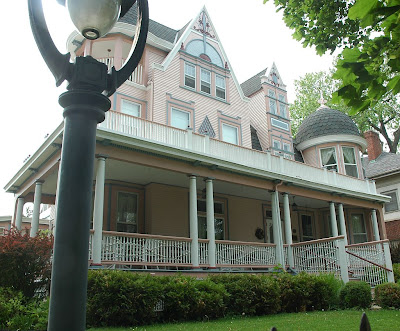
 Photo from the proposed historic district by Pete Selkowe
The city’s Landmarks Preservation Commission drew 125 people and the new mayor to a public hearing Monday night to gather input on a proposed historic district in neighborhoods from Eighth Street south to DeKoven Avenue.
The majority tilted against the district, which would place restrictions on renovations to historic properties. Opponents argued the district would take away property owners’ rights without compensation. They added it ignored the larger problem of rundown homes in the district that needed work.
Supporters, who were well represented at the hearing, said the district would protect a historic neighborhood.
Mayor John Dickert sat in on the hearing, but didn’t offer an opinion. His main role was to settle down an enthusiastic crowd that opened the hearing by clapping and cheering for the first opponent who spoke. Dickert said such outbursts wouldn’t be allowed so everyone felt comfortable addressing the commission.
City Planner Matt Sadowski said the ordinance was designed to prevent a new home built next to an old home that wasn’t in keep with the neighborhood.
He showed slides of new homes that overpowered neighboring houses and another historic home covered in bad siding and a poorly built porch. “We’re trying to protect the structure and protect the character” of historic homes, Sadowski said.
Monday’s meeting was the first in a long process to get a historic district approved. The ordinance would have to pass the landmarks commission, then go througha public hearing with the Plan Commission, pass that commission, then go through a public hearing with the City Council and then pass the City Council.
The ordinance isn’t on a fast track. The landmarks commission won’t consider the proposal until July 6, and may not even vote on the proposal at that meeting.
If Monday’s hearing is any indication the proposal will face spirited opposition from libertarian-minded residents concerned about government intervention into people’s homes. Opponents took turns arguing the ordinance violated their Constititional rights, took away their personal freedoms and hinted at the coming collapse of our society.
Lost in their argument were the practical aspects of an ordinance that likely contains more flexibility than many suggested. While historic properties would undergo review for significant renovations, the ordinance is more interested in protecting the appearance of buildings than historical accuracy.
For example, if the owner of a historic home wanted to replace windows they likely wouldn’t be limited to wood frames. They could use aluminum or vinyl as long as they maintained the historic look of the building, Sadowski said following the hearing.
But the ordinance seemed to strike a deeper chord with people than simple renovations to buildings. Many who spoke argued the ordinance simply encroached on their rights as property owners. The city’s intention may be OK, some argued, but they weren’t interested in city input on any decisions on their homes.
“These properties are not yours,” implored one College Avenue resident.
 Photo from the proposed historic district by Pete Selkowe
Landmarks commission member Eric Marcus ran the public hearing. He noted the proposal didn’t originate with the commission and that commission was simply gathering information from the public to consider how it wanted to move forward. Commission members offered no opinions Monday night on the proposal.
Wayne Clingman and a few other speakers offered a possible compromise. He suggested the city allow people to opt into the district if they want to.
Others went the opposition direction. They wanted every home in the district subject to the ordinance.
Any new construction in the historic district would be included, Sadowski said. But just because there’s a vacant lot doesn’t mean there will be a historic-looking home built. The ordinance only asks designers to consider surrounding homes in the new construction. For example, is the home roughly the same height as its neighbors?
There’s a good example unfolding now on South Main Street where a boxy modern home is being built among historic houses. Even with the historic district, Sadowski said, the modern home could be allowed because it fits in with neighboring structures.
But former mayor candidate Jody Harding saw a more sinister side to the proposal. Harding, who doesn’t live in the proposed district, invoked Ayn Rand in her opposition to the historic district, which she called a step toward a society where no “I” exists. She called the proposal “un-American.”
Roy Ramquist, 1526 College Ave., tried to lighten up the heavy hearing with an off-color joke. He noted one of Racine’s first mayors lived in his house. “There are no pictures of underaged women in the attic, so I guess he was OK,” Ramquist said. Dickert and the commission didn’t crack a smile at the quip.
Jokes aside, Ramquist suggested a compromise of have the historic district only apply to new construction.
 Photo from the proposed historic district by Pete Selkowe
“All of the people I know who live in this area truly love their homes,” said Carole M. Johnson, 1742 College Ave. “… where we live matters deeply to us. We appreciate your concerns for our neighborhood.”
Another woman wanted to know how her Park Avenue home could be included in the historic district. She said the ultimate goal should be to have every home in the district.
“A historic district can benefit absolutely everybody,” she said.
But John Pettinger, 905 Main St., wasn’t buying it. He said the ordinance amounted to forcible restrictions on peaceful citizens and called the proposal “disgraceful.” He promised to take a historic door in his home, cut it into pieces and give one to each member of the landmarks commission if the historic district was passed.
Michelle Ortwein, 1428 Wisconsin Ave., supported the district. She saw it as an opportunity to receive information and help in restoring a historic home.
Randy Moles, 1833 S. Main St., backed the proposal as a safeguard on new construction.
“If the house burns down next to me, there’s no restriction on what could go up there,” Moles said. “The value of my property relies on the value of the properties around me. We’re all in this together.”
But Joshua Bloom wondered about the need for the ordinance. The historic homes in the district are well cared for, so why do they need what amounts to city supervision?
“I don’t see what problem you’re trying to protect,” he said. “We maintain our houses with no compulsion of any law. We’d be nuts not to keep them up.”
“If you do want to preserve the neighborhood, handpicking the best homes won’t do it,” Bloom said.
A couple of people asked why the DeKoven Center wasn’t included in the historic district. DeKoven is located just south of the district’s border. City Development Director Brian O’Connell said the construction of Lake Oaks senior apartments divided DeKoven from the rest of the district, so the property was left out.
Marcus asked if the commission could add the property. O’Connell said they could.
Alex Sarrazin, 1753 College Ave., opposed to the ordinance as presented. While he appreciated the intent, he didn’t see much upside for the owners of historic homes.
“Frankly, what’s in it for me?” Sarrazin asked.
Marcus assured the crowd that the historic district was still under discussion. While a proposal is out there, it’s not a guarantee it will pass, he said.
“This is not a done deal,” he said. “This is the public hearing for us to understand your concerns.”


