Showing posts with label James Shaw. Show all posts

September 23, 2009

Shaw: Unified needs to expand options; Supports expanding Walden and REAL School, building two elementary schools


Racine Superintendent James Shaw delivered the annual "State of the District" address on Tuesday night. Here are a few key points of his talk:

* About 75 people attended the address at SC Johnson's Golden Rondelle theater.

* Shaw talked a lot about his "North Star" initiative, which is a goal to have every Unified student college or career-ready by the time they graduate. A key aspect of the "North Star" is measuring student and school performance.

* Shaw noted Racine has more impoverished children than most school districts in the state, but is spending less per student than most school districts in the state. "We are addressing above average needs with below average resources," he said.

* Unified is working on ways to use numbers to evaluate school safety. He said it's a priority to keep children safe in schools.

* Saying he wants to give parents "options," Shaw threw out a few innovative ideas:
  1. It's time for Unified to open a kindergarten through eighth-grade school, he said.
  2. Unified needs one or two new elementary schools to lower class sizes. An audience member asked if the former Caddy Vista Elementary in Caledonia would be an option. Shaw said no sites have been chosen for the proposed schools, but they would be built where kids live, and early analysis suggests the new schools would be needed in the city.
  3. Expand the Walden and REAL School programs to more students.
  4. Expand Advanced Placement (AP) and International Baccalaureate (IB) programs, which offer high-level classes to students.
  5. Open a virtual school that would allow students to attend classes online. Shaw said Unified is one of the few districts in the state not to have a virtual school option, and it's losing some students because of it.
* Shaw made an interesting point about looking to other districts as models. While they may help, he said, Unified has to find "The Racine Way" to improve. Essentially, the Racine area needs to fix its schools and can't look elsewhere for the answers.

* "The community wants a voice in Racine's schools," Shaw said. "They want a say." He added the community has supported Unified for years by passing referendums and working to improve the district.

* Unified's diversity is a strength, Shaw said. "It's a reflection of America," he said.

* Shaw's concluding point was to "never give up" on trying to improve Racine Unified. He told a story about reading an essay written by a high school student. He was moved by the essay and asked for the student to be recognized at a School Board meeting. The teacher said it wasn't possible, because the student was in juvenile detention. Shaw told the teacher he was "deeply disappointed." The teacher responded: "What are you going to do? Give up?" Shaw's response: "We don't ever give up."

* An audience member asked if Unified was working on a way to allow parents to check students' grades online. Shaw said the district is working on such a program. He also noted Unified trails many districts in offering this service, which is now limited to Case High School. "We need to move in that direction," Shaw said.

* Shaw said if his plans aren't working, the School Board should find someone new to lead the district. "If the needle doesn't move, the School Board should find a new superintendent," Shaw said.

He added similar accountability can't be brought down to the teacher level because there are too many factors that go into individual success. It's the administrators who should be held responsible for district-wide improvement.

"When schools don't make progress, central office has a problem," Shaw said.

June 9, 2009

Showing Progress: Four Unified schools improve scores to avoid state rebuke

Racine Unified showed encouraging results Tuesday on a state test designed to measure "adequate yearly progress" (AYP) for public schools around the state.

But even though four Unified schools showed improvement this year after falling short in 2007-08, Superintendent James Shaw said the district still had work to do.

"The district is not currently where it needs to be in terms of academic progress, but I believe that the district is poised to develop a comprehensive strategy to improve mathematics achievement at all schools," Shaw said in a prepared statement. "The development of our North Star vision has given the district the framework to ensure that all students graduate career and/or college ready."

Here's a breakdown of Unified's results:

The Good

Racine Unified as a whole received "satisfactory status" from the state Department of Public Instruction. The district had missed AYP the year before.

Goodland and Wadewitz Elementary Schools and Mitchell Middle School missed AYP in the prior year but met AYP this year. They're designated to be in satisfactory status.

McKinley Middle School also met AYP and is designated as Improved. However, the school must meet AYP for two years in a row to be removed from the "Schools Identified for Improvement" (SIFI) list.

Criteria for "satisfactory status" include:
  • 95 percent of enrolled students must take the state's standardized test
  • Elementary and middle schools must have an attendance rate of 85 percent
  • High schools must have a graduation rate of 80 percent
  • Schools must have a reading proficiency index score of 74 percent
  • Schools must have a math proficiency index score of 58 percent

The four schools that made AYP this year after missing it in the prior year all took part in Unified's "Data Retreat" during August 2008. Knapp, which missed AYP in one category, and Gilmore also participated in the retreat, which will be expanded to all of Unified's schools this year, according to the district.

The data-driven model is part of Superintendent James Shaw's plan to create a "data warehouse" for teachers, parents, students and the public to access Unified student data to evaluate public education in our community. The hope is putting data in people's hands will help them identify and solve problems, leading to better results.

Shaw talked about this on his blog. We reported on plans for a data warehouse here. A district-wide "data retreat" is scheduled for August where school districts from around the country will present the strategies they used to dramatically improve student achievement and close achievement gaps.

The Not-So Good

Two schools missed AYP this year in one or more areas for the first time. Jerstad-Agerholm Middle School missed AYP in reading and Gilmore Middle School missed in reading and math. These schools are designated satisfactory because they missed these areas for only one year.

Four schools continue in SIFI status. Case and Horlick High Schools missed in three areas, reading, math, and graduation rate. Park High School missed in math, graduation rate, and test participation.

Knapp Elementary was designated as a SIFI this year after missing AYP in math for two years in a row. Since Knapp is a Title I school, sanctions will apply and the school must meet AYP for two years in a row to be removed from the SIFI list. Sanctions include development of a school improvement plan (which is already a district requirement for all schools) and providing Knapp students with the option to transfer to another public school within Racine Unified.

Unified noted about Knapp's scores: "Knapp missed AYP for only one demographic group in math. The school did in fact make AYP across the other twenty-eight categories of the Wisconsin formula for determining AYP."

Unified said in a prepared statement plans are already underway to improve Knapp.
District administration will assist and support Knapp Elementary students and staff through a three-step process. Administrators began planning with central office staff last Friday and will conduct an Administrative Services Center (ASC) Data Retreat this week to create a school assistance plan for Knapp.

ASC staff will meet with Knapp staff next week to explain and discuss next steps. A meeting with Knapp parents will take place within two weeks. Further strategies which may be employed will include developing a more rigorous math curriculum, providing student tutors and teacher coaches, smaller class sizes, extended time for instruction, and best practices regarding parent engagement.
What else is being done

Unified officials saw hope for all of the district's schools in the results achieved by McKinley and Mitchell Middle Schools and Goodland and Wadewitz Elementary schools.

The district is also working on implementing a more rigorous reading and math curriculum for first and second-grade special education students. The inclusive practices will be expanded to more grades in future years.

And, the district is also rolling out a new research-based math program for sixth- to eighth-graders next year.

June 2, 2009

Shaw looks to develop leadership within Racine Unified

Racine Unified Superintendent James Shaw met with the Racine Unified School Board on May 28 to review his first nine months as head of the school district. The far-reaching conversation touched on several issues facing our public schools. We're breaking down the meeting by topic and will post stories over the next few days reporting on the meeting. See our first story here.


Superintendent James Shaw is reorganizing Unified's central office to focus on his priorities and to allow top administrators to develop priorities of their own.

Shaw’s plan puts district administrators in charge of different issue areas – such as redistricting, school safety and curriculum – and, by the sound of it, will push them to become the district’s leader on those issues.

It solves a couple of problems at once, Shaw said. First, it gets people working everyday on key problems in the district. Second, it improves leadership within the district and sets a succession plan if any leaves.

“We do want to build a pipeline of people for the future,” Shaw said. “We need three or four internal people assuming higher level positions.”

Part of Shaw’s plan includes hiring a full-time deputy superintendent to replace Jack Parker, whose interim contract expires at the end of June. But Shaw was cautious with the position, which will combine three vacant jobs into one. Following Van Atta’s advice from the business world, he told the School Board he wouldn’t hire someone unless they were a perfect fit.

“If we don’t have the right person, we won’t move,” Shaw said.

School Board Member Dennis Wiser said Unified needs to get away from relying on the superintendent to make improvements.

“We can’t afford to start over every time a superintendent leaves,” he said.

Shaw agreed.

“The big responsibility I have is succession, providing leaders to you, that you can have the flexibility of promoting within,” Shaw said. “You need to have some internal options to take a look at.”

He added: “We should be losing leaders to other school districts. That’s where we should be.”

Plan aside, Shaw said Unified has work to do at simply getting along both internally and with the community.

“The distrust thing is still here,” he told School Board members. “There is still significant distrust with people.”

The antidote, Shaw said, is creating a vision for success that everyone can follow.

May 29, 2009

Shaw sees 'data warehouse' as key to Unified improvement


Racine Unified Superintendent James Shaw met with the Racine Unified School Board on May 28 to review his first nine months as head of the school district. The far-reaching conversation touched on several issues facing our public schools. We're breaking down the meeting by topic and will post stories over the next few days reporting on the meeting.


Near the top of Superintendent James Shaw's wish list for Racine Unified is a warehouse.

OK, that's a little misleading. What Shaw really wants is a "data warehouse," which is an important distinction. Instead of storing inventory and equipment, Shaw wants to store numbers. Lots and lots of numbers.

Like every Racine Unified student's grades, test scores, attendance records, extracurricular activities, GPA, credits and anything else administrators, teachers, parents - even the public (student confidentiality would be maintained) - needs to evaluate and improve student, school and district-wide performance.

“The idea is to get data in the hands of everybody,” Shaw said.

Listening to Shaw talk, it's easy to see why he covets data. Many of his sentences begin with the phrase, "The research says ..." and Shaw often talks about using numbers to uncover problems and work out solutions.

Data warehouses are a growing trend in schools, and according to Shaw, Racine is falling behind other districts. Milwaukee and Kenosha both have data warehouses in place and are training staff to use them. For example, one database search can pinpoint freshman with high test scores but low GPAs, giving schools the opportunity to create study skill sessions for them.

Case High School is testing out a pilot version of what's possible. Parents of some classes can log into a website and check on test scores, assignments and other numbers.

Shaw has more ambitious plans for a more comprehensive system in every Unified school. The system would cost millions of dollars, but $10 million in federal stimulus money over the next two years is arriving just in time to create the data warehouse Shaw hopes to see. (The stimulus bill, which restricts how the federal can be used, actually recommends districts create data warehouses as a way to help the economy.)

“If we don’t have the bottom drop out, we should have enough money,” he said.

School Board member Dennis Wiser, a former math teacher, said math teachers have long requested a system to track students’ math history through grades and test scores. That’s the type of thing that can be included in the data warehouse, Shaw said.

Board member Julie McKenna said she's hearing demand for the system. “Parents want this,” she said.

As far as a timetable, Shaw offered a hint of frustration with the pace of change in Unified. One technician told him he could get a data system running by fall, but Shaw was skeptical.

“That’s not been my experience so far in Racine, that we can do those things so quickly,” he said.

But principals are creating data teams for the summer to figure out what should be included in the data warehouse, and at least the beginning of a system could be in place by next school year, Shaw said.

That said, Shaw said advice he’s receiving on the system is to “go slow and do it the right way.”

That means involving teachers and principals in the setup process and then making sure everyone in the district gets trained on how to use the system.

“It’s not that they have it,” Shaw said, “it’s that it’s used.”

One sticky question: When will teachers have time to crunch the data to gain insights on their students? Shaw said the district needs to figure out a way to give teachers time to do that work within the school day.

He’s hopeful the district can hire “coaches” to work with principals and teachers on how to use the system. The district had three such coaches – ex-teachers with years of experience and training - this year, and it helped principals learn how to use data to identify and solve problems, Shaw said.

February 4, 2009

Public education funding reform plan offered

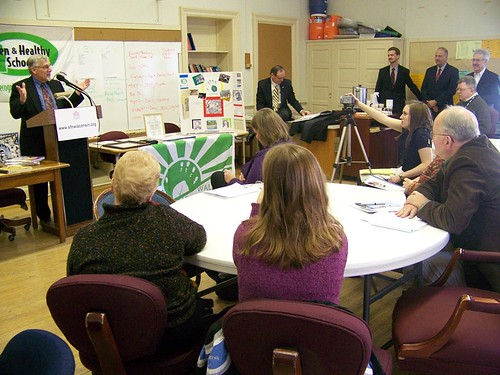
Dr. Jack Parker, deputy superintendent of Racine Unified, talks Feb. 4 at
Walden III School in favor of changing the state's school financing system.


By Paul Holley
For RacinePost


An ambitious, comprehensive and expensive state public education funding reform plan was introduced in Racine Wednesday by the School Finance Network. The plan’s backers conceded, however, that they’ll face challenges from a financially beleaguered Wisconsin Legislature.


SFN, which bills itself as a coalition of educators, school board members, parents and business interests, unveiled the plan at a mid-morning press conference held at Walden III Middle and High School. Nine similar events were scheduled throughout the state on Tuesday and Wednesday.

“If the current system was working, we wouldn’t be here,” said Jack Linehan, a retired school administrator and executive director of the Southeastern Wisconsin Schools Alliance. “The (funding) system we have in place once worked but it’s no longer valid. The urgency to change is there, recognizing the economic environment we’re in.”

More than two years in the making, the SFN proposal controls property taxes, increases state aid to local school districts, promotes economic equality among districts and addresses students, particularly the neediest – low-income, special education and immigrants, he said.

Linehan also pointed out that the proposed reforms already have broad-based support. SFN members include labor (AFT-Wisconsin and the Wisconsin Education Association Council) and management (Wisconsin Association of School Boards and the Wisconsin Association of School District Administrators). “Crises bring out the best in people,” he said. “You get the best ideas and you get people talking and working together.”

The 12-page SFN proposal calls for reforming the local school revenue controls enacted by the Legislature in 1993-94 that critics contend unfairly squeeze public education budgets. The proposal would tie school revenue controls to income growth instead of the Consumer Price Index and boost state aid for services where costs have risen more rapidly than the state-mandated revenue increases.

The plan also addresses how tax dollars are distributed among school districts; state aid to a laundry list of programs (i.e. low-income students, special education, English language learners, four-year-old kindergarten, transportation, security); increased efficiencies; property tax relief; the Qualified Economic Offer, and measurement of how the funding reforms affect school success. The SFN recommends a five-year phase-in period for some of the reforms. (The proposal and additional details can be found here.

When asked to place a dollar amount on the proposal, Linehan said a 1 percent increase in state public education spending would come in at $550 million a year for four years. He acknowledged that increased public education funding will be a tough sell among many state lawmakers.

At this point, at least, the SFN offers no funding specifics for the plan beyond a statement that lawmakers and the governor might consider “eliminating existing tax loopholes and tax breaks. . .or exploring possible federal funding.”

“I think a wise person will look at this as an investment in our educational future,” Linehan said. “I would counter that we can’t wait until the economy improves. I’m hearing more and more that there is a realization that we need to do something. And, I recognize that a debate has to occur.”
That debate will take place within a few weeks. Rep. Sondy Pope-Roberts, D-Middleton, Chair of the Assembly Education Committee, has agreed to hold a hearing on the SFN proposal on March 24.

Organizers of the Racine event turned out a varied contingent of public supporters. Speaking in favor of the SFN efforts were: Jack Parker, Racine Unified School District deputy interim superintendent; Herb Katt, owner of Katt Construction; Lisa Scott Ptacek, a parent and PTA member, and Julie Fornary, a Walden teacher.

Attending from RUSD were Superintendent Jim Shaw and School Board members Gretchen Warner, Don Nielsen and Julie McKenna.

The SFN has a created sophisticated grassroots mechanism that includes the organization’s website plus Facebook, MySpace and Twitter pages that promise video, podcast and blog updates. Representatives from a public relations firm were on hand to shepherd media members at the event.

“Today, marks the first step,” said Linehan. “I can’t say what is going to happen but at least we’re going to have a huge discussion about reforming education funding.”

November 10, 2008

Superintendent Shaw wants your input

Racine Unified Superintendent James Shaw is looking public input on what to do about our public schools. He's called a "Community Connections" meeting for Tuesday, Nov. 18 from 6-8 p.m. at the Cesar Chavez Community Center, 2221 Douglas Ave., in Racine.

The description of the meeting is vague. Shaw is simply inviting community members to share their concerns and opinions on issues facing the district. Participants can attend part or all of the event.

October 22, 2008

Superintendent Shaw handles his first mini-crisis

Racine Unified Superintendent James Shaw is proving adept at his new position. Here's ">his response to the mini-controversy over a textbook including an excerpt from Barack Obama's autobiography:
Shaw told the Racine Unified School Board on Monday that people in his administration made him aware of two parents who had complained about the issue, and a “thoughtful, reflective investigation” of the textbook flap was necessary.

[snip]

Jeff Weiss, director of curriculum and instruction, will conduct the initial review, and Shaw will issue a follow-up report to the board. Correcting any curriculum issues that violate district policy will be the first priority, Shaw said, followed by disciplinary measures if it’s appropriate.

The emphasis added is mine. Two points:

1. Shaw wasn't condescending. He's taking the parents' concern seriously and promises to address the issue.

2. Someone could get in trouble for this. If district employees violated district policy, it sounds like he's ready to act.

If you're trying to win over a skeptical public, taking their concerns seriously and enforcing existing policy seem like good places to start.

August 14, 2008

Unified hiring Dr. James Shaw as superintendent

UPDATE, 8/18: As expected, the Racine Unified School Board today approved the contract it had delegated Board President Tony Baumgardt to negotiate with Dr. James Shaw. The new superintendent is scheduled to start work as head of the district by Sept. 1.

--------
Racine Unified has all-but hired Dr. James Shaw as its next superintendent. All that's left for the board to do is meet in open session on Monday, Aug. 18, and formally approve the contract that Dr. Shaw has already signed -- that's his signature on the contract above.

The contract is for two years, which is as long as state law permits, beginning on Sept. 1, 2008, and ending on June 30, 2010, and calls for a salary of $180,000 per year (which comes to $150,000 for the school year running from September 2008 to June 2009). The contract also states that Shaw comes into the district with a "bank" of 60 days of paid sick leave, 20 paid vacation days, five professional days and a car allowance of $850 per month.

Because Shaw has "retired" for purposes of the Wisconsin Retirement Fund, the district will not pay anything into the fund on his behalf. Instead, Shaw will accrue $20,000 per year in deferred compensation if he remains here for three years. The district also agreed to pay his moving expenses here from Lake Mills, WI, and to pay $20,500 into his 403(b) retirement savings plan.

The last contract of Dr. Tom Hicks, the district's previous superintendent, called for a salary of $144,000 per year, plus $15,000 into his retirement savings account. The district reportedly was willing to offer Dr. Barbara Pulliam, its first choice for the post this year, a $170,000 contract.

Here's a statement issued today by Tony Baumgardt, Racine Unified Board President:
“The overall public response to Dr. James Shaw’s candidacy for superintendent has been overwhelmingly positive. The community seems to be very impressed with Dr. Shaw’s credentials and background and has indicated support for his candidacy. During executive session last week, the Board gave me authority to negotiate a contract with Dr. Shaw. Dr. Shaw has now approved the terms and conditions of the contract, and the School Board will be meeting in open session next Monday, Aug. 18, to vote on Dr. Shaw’s contract as the terms and conditions still need to be approved by the Board.

"Attached you will find a copy of the contract as it stands without full board approval and it is important to note that we have reviewed comparable districts that have recently hired superintendents in the state. I believe we are in line with someone of Dr. Shaw’s experience an expertise.

"I want to thank those who participated in the small group interviews as well as the community forum for their feedback as well as the community for their support as we searched for a superintendent. I believe this is a positive step for Racine Unified and our community.”
Here's the story we wrote about Dr. Shaw's public visit here on July 29.

August 1, 2008

The chutzpah of Dr. Barbara Pulliam

In Yiddish there's a word -- chutzpah -- that roughly translates as unmitigated gall, brass balls, selfish insensitivity. The dictionary genteelly defines it as "utter nerve, effrontery."

Well, tonight we have another definition:
Chutzpah = Dr. Barbara Pulliam
Yes, that Barbara Pulliam: the educator chosen on April 29 by the Racine Unified School Board to be its next superintendent, expected to start work on July 1. Except that on June 10, after more than five weeks of contract negotiations, she suddenly called Unified’s attorney Gib Berthelsen, to announce that she had taken another job.

Actually, she didn't even have the class to make that call herself; her attorney called Berthelsen.

Well, that was then, this is now. A week or so ago, we'd heard that things weren't going too well for Dr. Pulliam in Greene County, Georgia, where she hastily became interim superintendent, after the school board there bought out its existing superintendent after just one year of a three-year contract, and interviewed and hired her in the same week.

Actually, we heard two things: One, that she had quickly rescinded her predecessor's controversial plan to put all the district's children in uniforms, and in gender-specific classrooms; no mixing of the sexes. Second, we'd heard -- but didn't bother to verify since we really didn't give a darn and didn't write anything at the time -- that turnover among the school board that hired her is expected to replace her best friend on the board and others who'd supported her appointment. So her job -- paying $155,000 per year -- might be in jeopardy. Karma, we thought; what goes around, comes around.

The first point above we know is true; the second is still hearsay.

But what we now know as fact -- having confirmed it with a member of Unified's School Board -- is this:
Dr. Barbara Pulliam is willing to come to Racine after all!
Don't all stand up and cheer at once.

Yes, about two weeks ago, she called Gib Berthelson to let him know that she was willing to forgive and forget and come to Racine as superintendent; let bygones be bygones as it were. We don't know what went on in Gib's mind -- we can guess -- but we're told he said to Pulliam: "I'll tell the board, but don't make any travel plans."

As far as the board is concerned, "Thanks, but no thanks." LOL.

Meanwhile, the board hasn't yet voted whether to offer the superintendent's job to Dr. James Shaw, the UW-Madison professor who was here this week meeting with teachers, administrators, parents and the public, continuing his interview for the job. But at the same time, almost everyone sees such a vote as a formality; Shaw was very impressive. He's also the board's only candidate.

At least one school board member told me the only question is salary, and Shaw will be given a pay package comparable to superintendents in peer districts, probably about $170,000 plus benefits.

There's also the expectation that Shaw will be his own man, independent in many respects from the school board. For example, he is said to have told them already that the much-vaunted Quality District Model implemented by former Supt. Tom Hicks was OK -- twenty-five years ago!

July 29, 2008

Meet Unified's next Superintendent candidate

Dr. James Shaw at open forum Tuesday night

It was about halfway through the 45-minute question-and-answer session, after Dr. James Shaw's 45-minute presentation about the achievement gap in schools, and what to do about it, when someone asked the key question of the only candidate to become Racine Unified School District's next superintendent, the only hope the district has of avoiding another school year with an interim in charge:

"If you didn't apply the first time around, why now?"

It was a great question, clearly on everyone's mind after the district's disastrous first attempt at finding a superintendent. The search firm-produced finalists all came with -- what's the accepted term: baggage -- and yet the district picked one of them anyway, only to be dumped at the altar. In fact, it had been in this very same hall -- the Golden Rondelle Theater -- that many in the audience had been exposed to that first round of three candidates. It had not been a night to remember fondly. And yet, here we were again, at another meet-the-candidate night. Why Shaw; why now? What are we getting into?

He handled it very well, a modest, soft-spoken, engaging candidate seemingly as surprised by his current position as much as we are. "I wanted to work on closing the achievement gap at the university. I had the sense good things were happening in Racine, and then I read the paper. And the Public Policy Report described Racine as the worst of 10 districts it was compared to. After Racine went through the search and didn't have a candidate, I made an innocent inquiry: 'How can I help?' "

And here we are today, with Shaw as the only candidate on Unified's radar. He's just come through two days of community meetings, culminating in last night's public forum at the Rondelle, attended by about 150 people. "I had three wonderful days here... well, two days but it seemed like three. I have met parents and teachers who are very proud of Racine Unified, but they want improvement. Racine is poised to make major improvements in closing the achievement gap."

Well, it had better be -- because the gap in reading and math skills between black and white students, rich and poor, is considerable, as the Public Policy Report and WKCE test results show, year after year. "We have huge achievement gaps," he said. "I know what your reaction is to these numbers: You want to change them. That's my reaction, too." Shaw was asked by the school board to tell how he'd address that gap, and he spoke for 45 minutes, finally winding up with, "I sound too much like a professor. I'm trying to sound like a superintendent."

In Shaw's educational universe, "It's the teachers who are important." His goal -- doubling the number of kids in the "advanced:" category in five years -- focuses on teachers. "Most of the variable is teachers so you focus on teaching. You try to use techniques that are effective with different kinds of kids." And he also would use a pay-for-performance plan to reward the best teachers.

Although he's been a professor at UW-Madison for five years, he had a key criticism: "At the University of Wisconsin, the best teachers get the best kids. That system is not working. We need to share the best teachers with the kids who are struggling." And he wants to improve teaching at Unified first by speeding up the hiring process, cutting through the delays that let the best new grads commit early to other districts, and by developing our existing teachers through active coaching. "Teachers working with other teachers, not just lectures. Professional development must be embedded in the schedule," he said.

"The most common reason teachers become teachers is to make a difference. I know Racine teachers want this. When people are so focused on closing the achievement gap, that creates a different environment."

Shaw said he produced a five-year plan aimed at doubling performance at the request of the School Board, but he insisted it was just preliminary; any real plan would be developed with input from teachers, administrators, parents, the community. And, he set out an ambitious first 90 days for himself, if he gets the job: reviewing data, picking the brain of Interim Supt. Jack Parker, joining three local organizations, visiting all the schools and meeting with teachers, followed in each case by a forum with parents, 50 interviews with business leaders, meeting REA leaders and forging a relationship, meeting with all the administrators, and on and on.

Shaw also handled questions from the audience. After the break, some of the Q&A:

How do you feel about classroom sizes? "Madison spends $2,500-$2,700 more per student than Racine, and there's a big difference in class sizes. I saw 35 in one middle school here. It really makes the task of engaging much more difficult. It's a major challenge. I would like to see smaller class sizes. I don't know how to achieve it here -- maybe through reallocation of resources."

How do we get black reading scores up? "Kids who are read to at home do better; we've got to engage parents. We've got to be more explicit about what parents can do at home."

RUSD is a unique animal: urban and suburban. It represents itself as an urban district, but 2/3 of its tax revenue is from the suburbs and 40% of the kids don't attend Unified and the 60% who do are unhappy. How are you going to work for the 2/3 that pay the tax bill? "It's important for the schools to serve all of the kids. If there's a sense that's not happening, it's regrettable. If these kids are not enrolling in Unified, we need to ask the parents why. I trust parents as the most reliable advocates for their kids."

I'm a school social worker and our ranks, and despite the growing need, our ranks and guidance staffs are declining. What would you do? "I think that is a loss," Shaw said, blaming declining resources. "Our support has to be the classroom teacher. That inevitably leads to cuts in music, athletic programs and the important work that social workers and psychologists do. I don't know that we can restore past cuts, but I hope we can avoid future cuts."

We're urban, suburban and rural, but the focus is on urban. How can you bridge that gap? "We've got to create a culture of excellence for all populations."

You've avoided any mention of No Child Left Behind. Why? "I like No Child Left Behind; it makes us look at data. What I don't like about it is that it's unrealistic. Over time, every school will fail; it's kind of meaningless. And I know many teachers, many professors really dislike it. But that law has made the achievement gaps more recognizable."

So what happens next?

The school board collected feedback from those at Tuesday's Golden Rondelle session, and those who met with Shaw over the past two days. Then it will have to decide whether to make him -- their White Knight -- an offer, or start the whole process over once again.

My money is on the board hiring Shaw. As school board member Julie McKenna told me -- remember, she's one of only two board members who voted against the hiring of Dr. Barbara Pulliam, who stiffed us without even a personal phone call after more than a month of salary negotiations -- anyway, as McKenna said: "You don't always get exactly what you want." She listed Dr. Shaw's negatives as his age -- 62 -- and the fact that he has not had big-district superintendent experience. Even she realizes these are minor negatives in the great scheme of things (especially when you consider the ones brought by Unified's previous candidates).

Dr. Shaw's CV is HERE.

July 10, 2008

Superintendent Shaw? Strong candidate emerges for Unified's vacancy

WEAC President Stan Johnson (left) presents the Friend of Education Award to former Menomonee Falls School District Superintendent James Shaw in 2001.


Geez, where was this guy a few months ago?

Dr. James Shaw, a professor at UW-Madison, is the surprise front-runner for Racine Unified's vacant superintendent's job. He also looks like the best candidate yet to apply for the job. Shaw has been a teacher, administrator and researcher, served as head of the Wisconsin Association of School District Administrators and was named state superintendent of the year. (Click here to download his CV.)

Plus, a quick check on Google turned up no skeletons in his closet - already a big improvement over previous finalists. The funny/sad part of this: Shaw contacted Unified for the opening. Go figure, you post a job opening and candidates apply without hiring a search firm for $30,000.

Dr. Shaw, welcome to Racine.

Here's the full release from Unified:
RUSD School Board to Interview Superintendent Candidate

The Racine Unified School Board will be interviewing Dr. James Shaw for the Superintendent of Schools position on Monday, July 14. Dr. Shaw contacted the district's attorney last month to inquire about the vacancy and to discuss if his leadership would be mutually beneficial. After a review of Dr. Shaw's qualifications, the school board has agreed to interview him next week. The School Board will update the parents, staff, and community on the next steps, if necessary, in the process after the interview.

Dr. Shaw currently serves as a clinical professor at the University of Wisconsin-Madison, where he views his role to better connect University research and leadership practice to improve public education. His goal is to advance leadership practices that promote equitable, high quality student learning, as well as systemic organizational and professional learning. His leadership experience at the University includes serving as Director of the Wisconsin Idea Executive PhD Program and Coordinator of the Master Administrator Capstone Certificate Program.

Dr. Shaw's leadership experience in K-12 public education includes serving as CESA Agency Administrator, Superintendent of Schools, School Business Manager, Director of Curriculum and Instruction, Director of Pupil Services, School Psychologist, and Social Studies Teacher. Before joining UW-Madison, he served as Agency Administrator for CESA #2, which provides programs and services for 72 school districts and has an annual budget exceeding $8 million. He served as Superintendent of Schools for the School District of Menomonee Falls for 10 years before joining CESA. He also worked for the School District of Kettle Moraine for 17 years serving as Assistant Superintendent for Business, Assistant Superintendent for Curriculum and Instruction, Director of Student Services, and School Psychologist. He began his education career as a Social Studies teacher in Waukesha.

Dr. Shaw received his BA in Psychology and Philosophy from Marquette University; his MS in Educational Psychology from the University of Wisconsin-Milwaukee; his PhD in Educational Administration from the University of Wisconsin-Madison. He has been recognized for his work in education by many organizations. Some of Dr. Shaw's recognitions include the Distinguished Service Award from the Wisconsin Association of School District Administrators, Distinguished Achievement Award from the University of Wisconsin-Madison's School of Education, Friend of Education Award from the Wisconsin Education Association, and Wisconsin Superintendent of the Year from the Wisconsin Association of School District Administrators and the American Association of School Administrators.

Dr. Shaw has several published works including: Doubling Student Performance: A School Leaders Guide to Closing Achievement Gaps and Improving Learning for All Students, Comprehensive Leadership Development: A Portrait of Programs, The Master Administrator Capstone Certificate: Professional Development for Advanced K-12 Educational Leaders, and Instructional Leadership and Technology. He also serves on the Board of Directors for Phi Delta Kappa's University of Wisconsin chapter, a member of the American Educational Research Association, an advisory board member for the Wisconsin New Teacher Project, and a member and former president of the Wisconsin Association of School District Administrators.